 Brainerce Help
Set up shipping zones and rates
Define where you ship and how much it costs, with flat, free, weight-based, price-based, or local pickup rates.
A zone is a group of places you ship to; a rate is a shipping option (and its price) inside that zone. Set both up under Shipping → Zones & Rates.
1. Create a zone
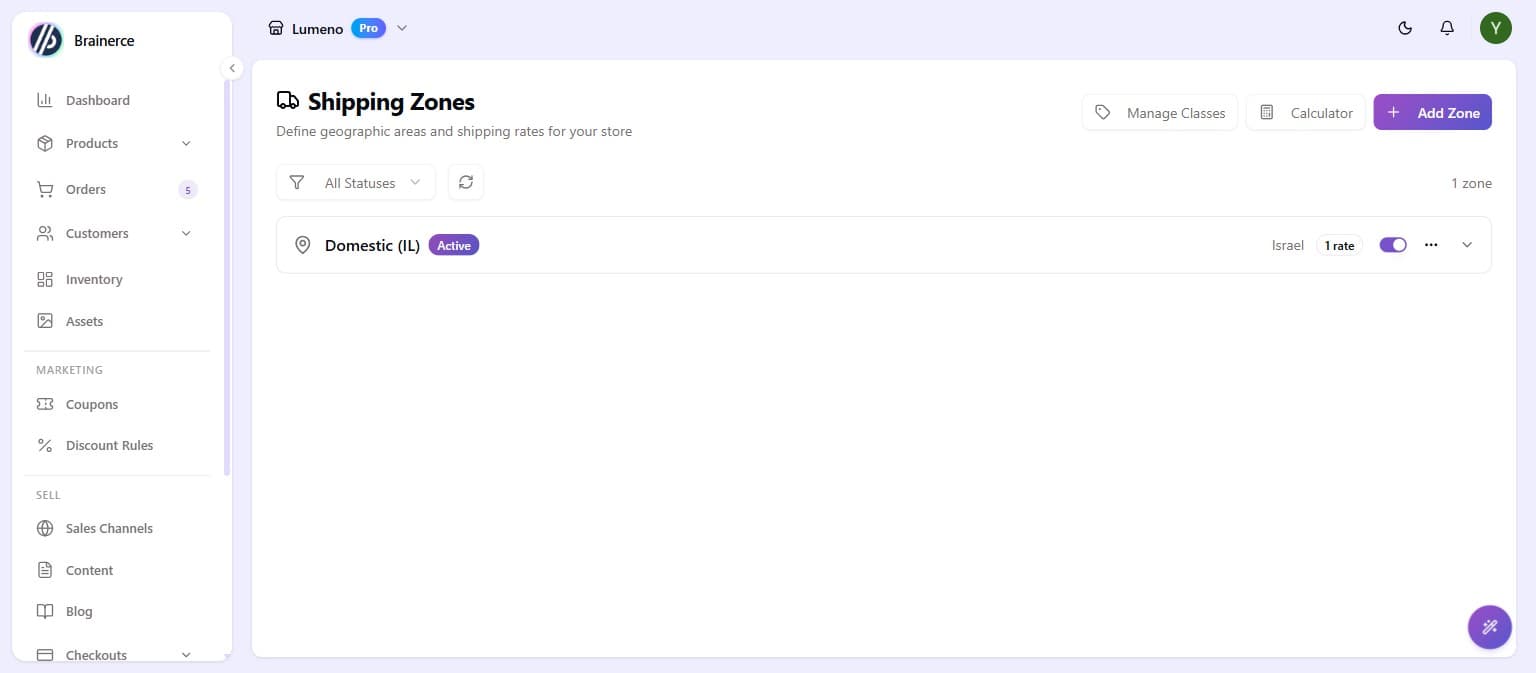
- Go to Shipping → Zones & Rates.
- Click Add Zone.
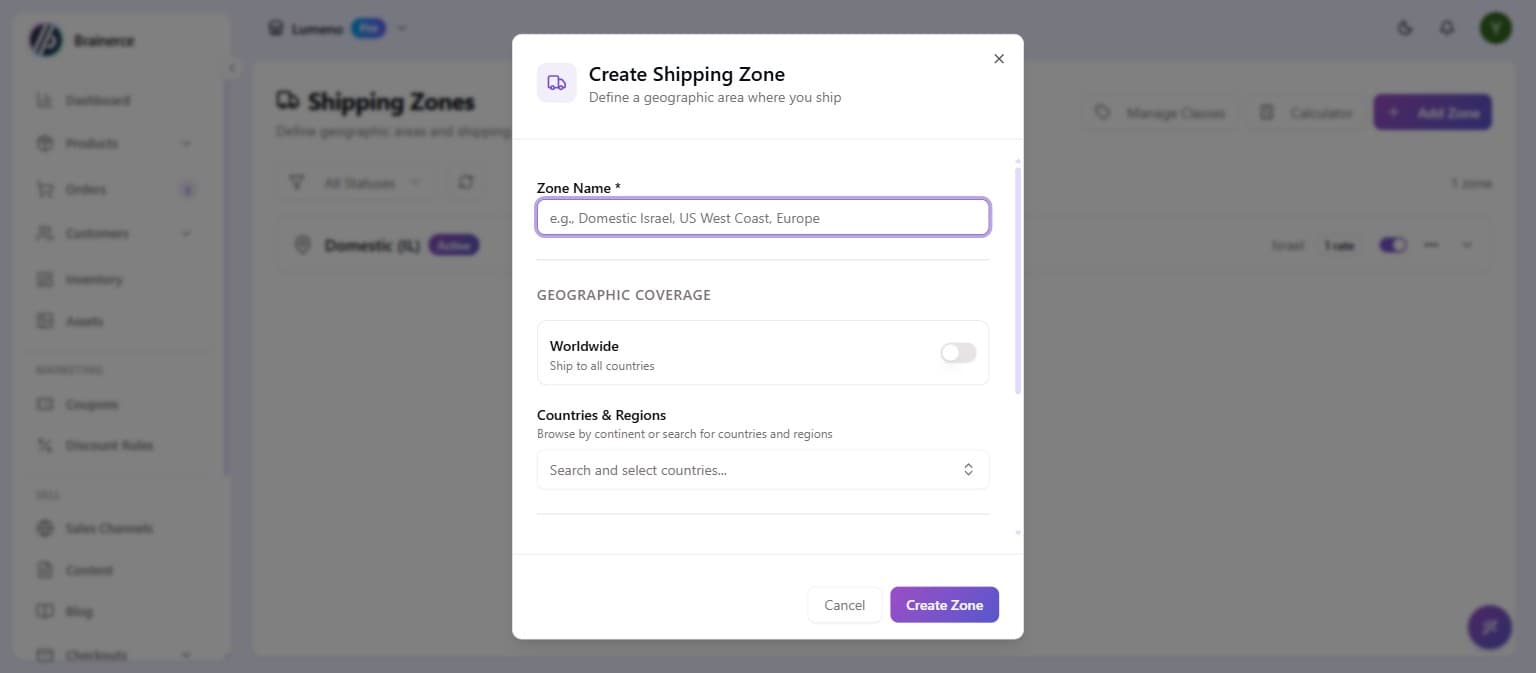
- Give the zone a Zone Name (e.g. United States, Europe).
- Add the Countries it covers, or turn on Worldwide to cover everywhere.
- (Optional) Narrow it with Postal Codes, set a Priority (lower numbers are checked first), and leave Active on. Leave Availability by currency region empty unless you know you need it. See Why a zone is never offered below.
- Click Save.
2. Add a rate to the zone
-
Expand the zone and click Add Rate.
-
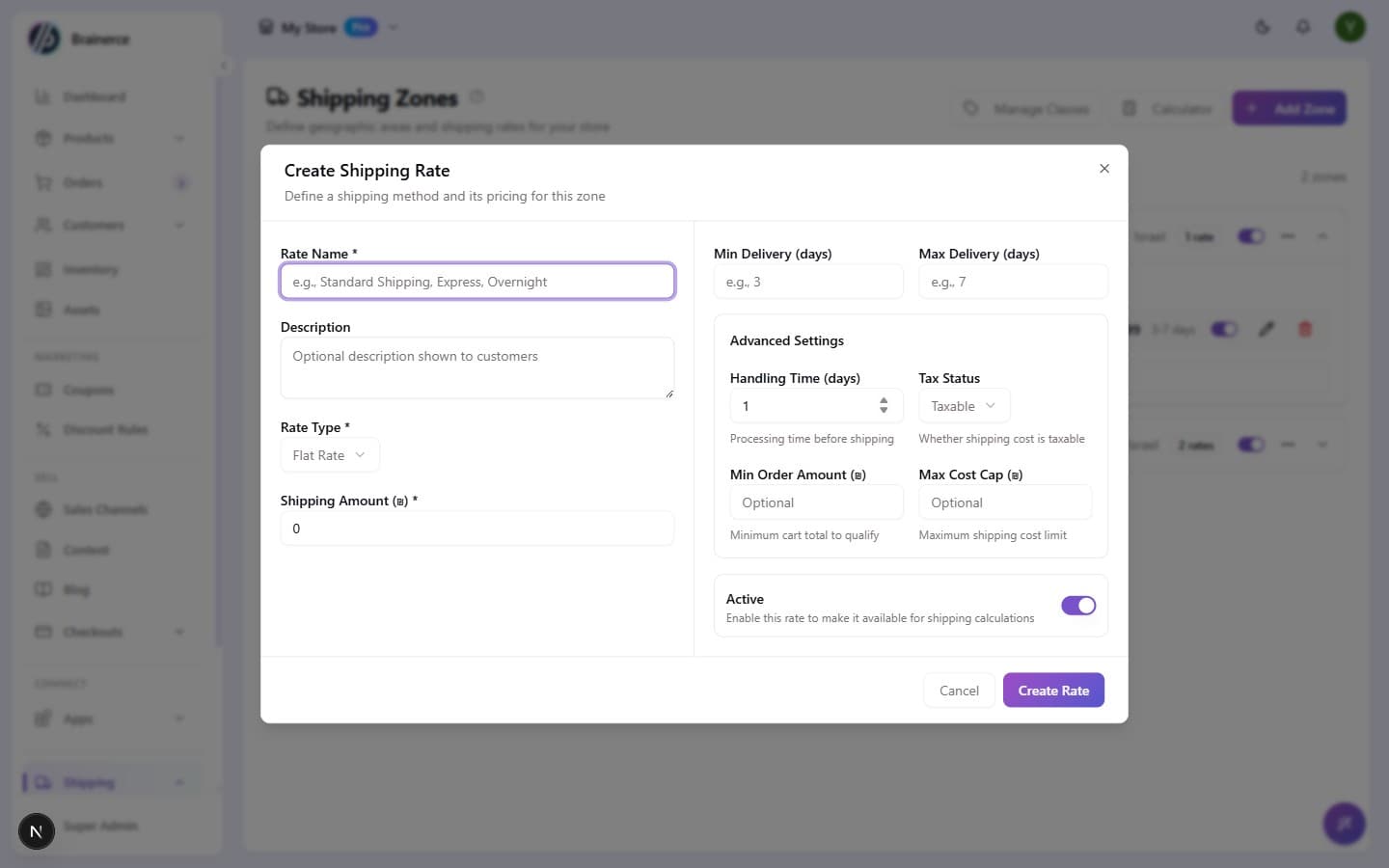
Give it a Rate Name (this is what customers see at checkout) and pick a Type:
Rate type What it does Flat rate A fixed price per order. Free shipping Free for every order the zone matches, or only above a minimum you set. Weight-based A base price plus an amount per unit of weight. Set a maximum weight and the rate is not offered above it. Price-based Different prices by order subtotal (tiered). Local pickup The customer collects in person at a location you set. -
(Optional) Add a Description, estimated delivery days, and a handling time. Under Advanced Settings you can also set a Max Cost Cap (the calculated price never goes above it), a Min Order Amount (the basket total a customer must reach before this rate is offered), and a Tax Status. All three are applied at checkout.
-
Make sure the rate is Active and click Save.
Free shipping over a certain amount
Add a Free shipping rate and put your threshold in its Minimum Order Amount box: 50 for "free delivery over $50". Below that basket total the free rate is not offered; at or above it, delivery is free. This is applied at checkout, and the dashboard calculator shows the same thing.
The total compared against your threshold is the basket after discounts. A $60 basket with a $15 coupon counts as $45, so it does not reach a $50 threshold. Set the number with that in mind if you also run coupons.
Always leave a paid rate in the same zone. A free rate that isn't offered leaves nothing in its place: if it is the only rate in that zone, a customer under your threshold sees no delivery option at all and cannot finish the order. Pair every "free over X" rate with a normal paid rate in the same zone.
A Price-based rate does the same job in one rate, and is the better choice if you want a real price below the threshold: give it a tier that costs your normal price from $0, and a second tier from $50 upwards that costs zero.
The sales-channel free-shipping threshold (set per channel, not on the rate) is a separate mechanism: it zeroes the price of rates above the amount you set, rather than hiding them below it. The free-shipping check on the Calculator page (see below) tells you whether such a threshold has a FREE-type rate behind it at all.
Two fields, similar names. The Minimum Order Amount box on a Free shipping rate is the "free above this" threshold. The Min Order Amount under Advanced Settings is a different setting on every rate type: it hides that rate entirely below the amount. Both are applied at checkout, and you can set both on one rate.
Is VAT charged on the delivery charge?
By default yes, whenever a tax rate matches the customer's address: the delivery charge is taxed at your standard rate, the same one used for products with no tax class.
To stop that, open the rate, and under Advanced Settings set Tax Status to No Tax. Postage on that rate is then not taxed at all, and the customer pays the delivery price exactly as you entered it. Leave it on Taxable (the default) and nothing changes.
Two limits worth knowing before you rely on it:
- It is per rate, not per country. If one rate serves several countries and only one of them exempts delivery, Tax Status cannot express that, so split the countries into separate zones with their own rates.
- Delivery is always taxed at your standard rate when it is taxed. You cannot put the delivery charge in a reduced tax class.
- Live carrier rates ignore it. A rate quoted by a connected carrier app is always taxed; Tax Status only exists on rates you create yourself.
Whether delivery is taxable where you sell is a question for your accountant. Brainerce applies whatever you set here and does not check it against any jurisdiction's rules.
Shipping classes: charge more for certain products
Some products cost more to ship (bulky, fragile, oversized). Use Manage Classes on the Zones page to create Shipping Classes, which are named groups like "Oversized" or "Fragile". Assign products to a class, then on a rate add per-class costs: an extra charge that applies per class, per order, or per item. Products without a class just use the rate's base cost.
3. Preview which rates apply
Use the shipping calculator to enter a destination (and optional weight/price) and see which rates a customer there would be offered, which is handy for checking your zones before you launch. It prices rates with the same calculation the live checkout uses, so what it shows is what a customer there would be offered. One thing to watch: it knows nothing about discounts, so when you are testing an order-total threshold, type the basket total after any coupon has come off. See Test what a customer would pay below.
How it appears at checkout
When a customer enters their address, Brainerce picks exactly one zone for that address and shows only that zone's rates. Several zones can cover the same address, but only the winner supplies the delivery options; they are never combined.
The winner is chosen in this order: lowest Priority number first, then a drawn shape beats a country list, then the smaller drawn area wins. So a neighbourhood you drew inside a country-wide zone takes the address, and the country-wide zone's rates are not offered alongside it.
This is why you may not see both your rates at checkout. If a rate you expected is missing, it is usually sitting in a zone that lost, not switched off. Put its zone on a lower Priority number to make it win. If nothing matches at all, the customer sees no shipping option, which can stop the order, so double-check that your zones cover every place you sell.
A rate can also drop out because of the basket, not the address. The winning zone's rates are each checked against the customer's basket, and one is hidden when the basket is below its Min Order Amount, below a free rate's Minimum Order Amount, or above a weight-based rate's maximum weight. That is the point of those fields, but it means a zone whose every rate has a threshold can leave a small basket with no delivery option at all. Keep one rate in each zone with no thresholds on it.
Drawing a zone on the map
Countries and postal codes don't always describe where you actually deliver. The Geographic Coverage panel lets you draw the area instead: search for a place, or draw a shape directly on the map, and the zone covers exactly what you outlined. You can draw several shapes for one zone and label each.
This is the right tool for local delivery ("within these streets", "this side of the river") where a postal-code list would be both long and wrong.
Some addresses arrive with no country
Address search does not return a country for every place. For certain settlements, including ordinary residential addresses in Israel such as Ramat Shlomo, Givat Ze'ev, Modi'in Illit and Ma'ale Adumim, the address lookup comes back with the street and city filled in but the country blank, because the map provider declines to attribute them to one.
A zone that works from a country list can never match such an address. A blank country is in nobody's country list, so the zone is skipped and the customer sees no delivery option, which looks exactly like shipping being broken, and is the most common reason a merchant reports it. Only two things cover these addresses: a shape you drew on the map over the area, or a zone with Worldwide turned on.
Brainerce does not guess the missing country, and it deliberately does not fall back to your store's own country, because that would silently ship the wrong quotes. The customer can still pick the country themselves in the checkout form, and once they do, a country-list zone matches normally. But you cannot rely on that happening.
If you deliver to any of these places, draw the area on the map rather than listing countries. Then test it in the Calculator below with a real street address from that area, not just the city name.
Why a zone is never offered to anyone
A zone can be switched on, cover the right streets, and still never appear at checkout. The zone list marks these with a Never offered badge; hover it for the reason. There are five:
- Every rate in it is switched off, so there is nothing to offer. (A zone holding only a local pickup rate is fine and is not flagged, because pickup is offered at checkout for the whole store, without matching the address. It just never appears as a delivery option.)
- Availability by currency region is set. This field is not geography. It refers to the currency/tax regions under Settings → Regions (e.g. one region charging in shekels, another in dollars), and it is checked before the map is. A zone limited to a currency region is skipped unless the delivery address's country belongs to that region: it follows where the parcel goes, not the currency the shopper happens to be browsing in. (If the delivery country belongs to no region, the checkout's own region is used, then your default region.) Unless you deliberately price by currency region, leave it empty.
- Restricted to a different sales channel. See the next section.
- It covers nowhere, with no countries selected and no shape drawn.
- It lists countries, but the address arrived without one. Address search returns a blank country for some places. See Some addresses arrive with no country above. A country-list zone can never match a blank country; only a drawn shape or a Worldwide zone can.
Nothing about a delivery address makes a zone "wrong" on its own: if a customer says they can't get delivered to and you believe they should, check these five before redrawing the map.
Limiting a zone to one sales channel
A zone can also carry a Sales channels restriction, so it only applies to buyers from the channels you pick. Use it when a marketplace and your own storefront ship on different terms. Leave it empty and the zone applies everywhere.
Test what a customer would pay
The Calculator button on the Zones page opens a rate calculator: enter an address and a basket, and it shows which rates match and what they cost. Use it after any change to zones or rates. It is much faster than putting a test order through checkout, and it tells you why nothing matched when nothing matches.
The Calculator and the real checkout price rates identically. Both run the same calculation, so a rate the Calculator drops for a basket (under its Min Order Amount, under a free rate's Minimum Order Amount, or over a weight-based rate's maximum weight) is a rate a real customer with that basket is not offered either. Enter the basket total and weight you want to test, not just the address.
Enter the total after any discount. At checkout these thresholds are measured against the basket total once coupons and automatic discounts have come off; the Calculator has no notion of discounts and takes the number you type at face value. A $60 basket with a $15 coupon must be tested here as $45, or the Calculator will show a "free over $50" rate the customer won't get. The Calculator also can't know a live carrier rate's own availability rules, so confirm those with a test order.
Under the results it lists every zone that did not take the address, with the reason for each: outside its countries and drawn areas, excluded by its currency-region restriction, restricted to another sales channel, covered it but has no active delivery rate, or covered it but lost to a zone with a lower Priority number. If it says the address could not be placed on the map, add the street and city, because without a street an address can only be located at the centre of the city, and a zone drawn around a neighbourhood can never match that.
The same page carries a free-shipping check, which compares each sales channel's free-shipping threshold against the FREE-type rates you've configured. A threshold with no matching free rate behind it silently never triggers, and this is what catches it.
What's next?
Need a hand? Email [email protected].