 Brainerce Help
Set up taxes
Turn on tax collection, choose inclusive or exclusive pricing, and add tax rates by country or region.
Set up tax under Settings → Tax. You'll turn on collection, choose how prices show tax, then add one or more rates.
Brainerce does not decide where you owe tax. Every rate here is one you enter by hand. Brainerce does not register you for VAT, GST or HST anywhere, does not track nexus thresholds, does not watch your sales volume against any state's registration limit or Canada's small-supplier threshold, does not update rates when a jurisdiction changes them, and does not file returns for you. It applies the rates you configure to the addresses you configure them for, and nothing more.
Working out where you are registered, what the rate is, and whether a given product or shipping charge is taxable in that place is yours (or your accountant's). Getting it wrong is a liability Brainerce cannot catch for you.
1. Turn on tax collection
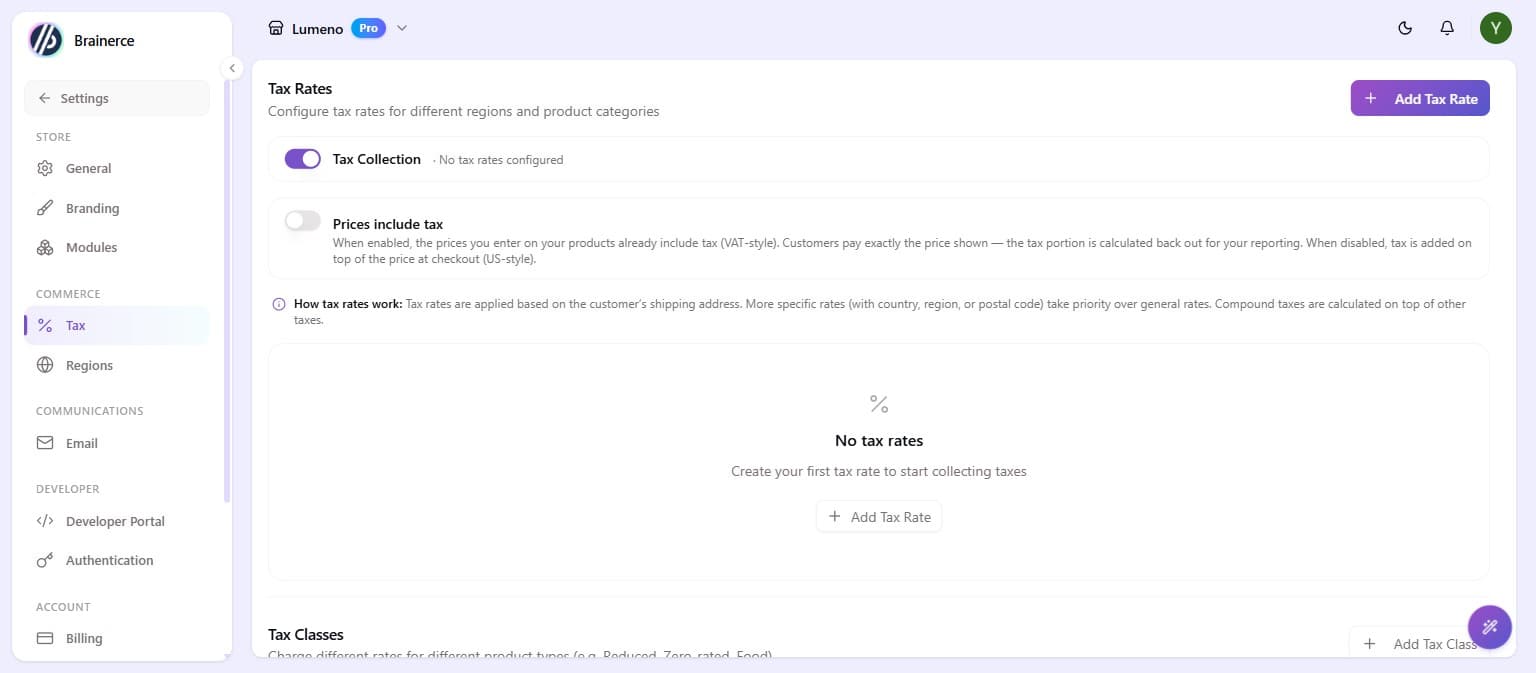
Enable Tax Collection at the top of the page. Until this is on, no tax is calculated and the pricing toggle below is locked.
2. Choose inclusive or exclusive pricing
Use the Prices Include Tax toggle:
- Off (exclusive). Your prices don't include tax, and tax is added at checkout. This is the typical US sales-tax model.
- On (inclusive). Your prices already include tax, and Brainerce backs the tax out for display. This is the typical EU/VAT model.
3. Add a tax rate
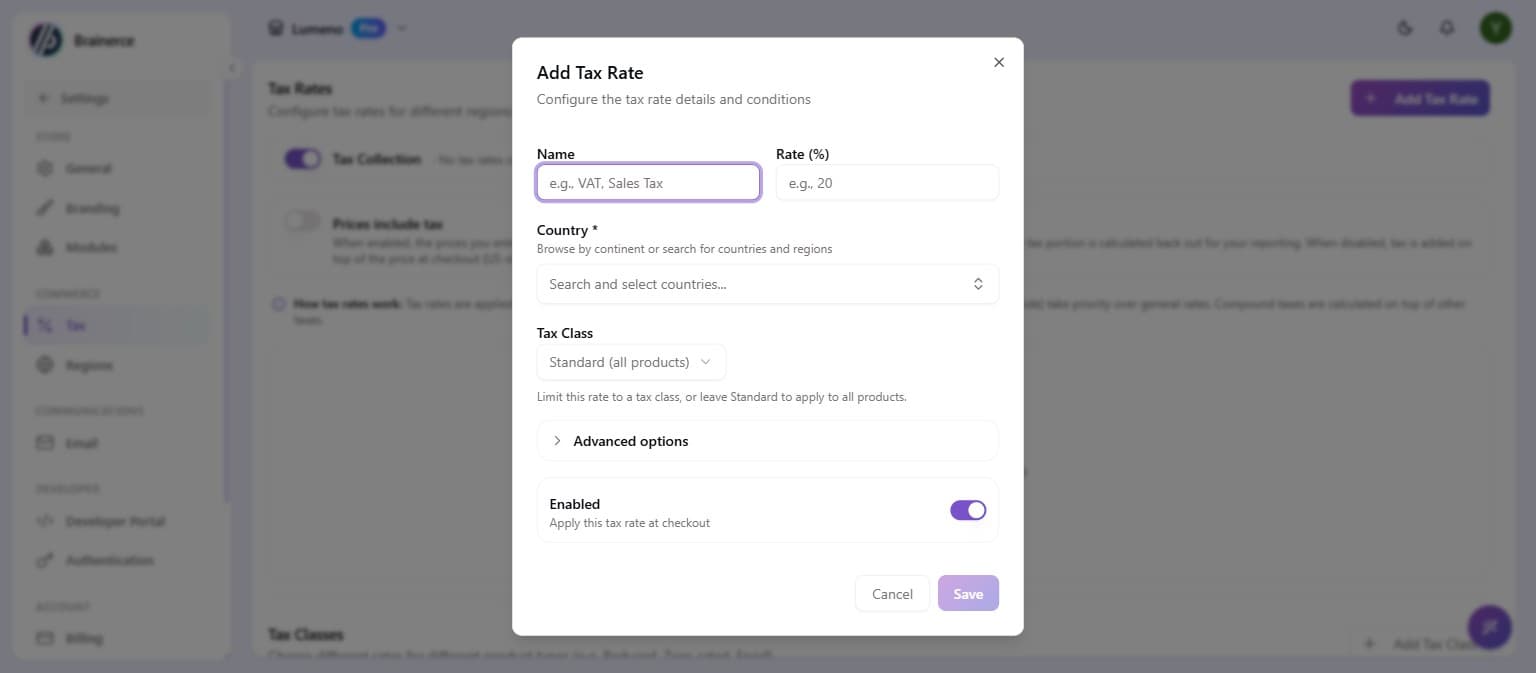
- Click Add Tax Rate.
- Fill in:
- Tax Name, shown on invoices (e.g. Israeli VAT, California Sales Tax).
- Tax Rate Percent, the percentage (e.g.
17). - Tax Country: one or more countries this rate applies to. All of them are matched at checkout.
- Tax Class. Leave it on Standard (all products) to charge the rate on everything, or pick one of your own classes to charge it only on the products in that class. A class you created and named "Standard" is not the same thing as the Standard (all products) option at the top of the list.
- Leave Charge together with other rates off unless two taxes genuinely apply to the same sale, such as Canada's GST plus a province's PST or QST. When you do turn it on, every rate you want charged together has to have the same Tax Class. Two rates split across different tax classes are never charged together, however you set this toggle. See When two taxes apply to the same sale below.
- (Optional, under advanced options):
- Region/State and Postal Code to target a rate more precisely.
- Priority to break ties when several rates are equally specific.
- Make sure Enabled is on and click Save.
How rates are matched
For each order, Brainerce picks the most specific matching rate: a postal code match beats a region match, which beats a country match. If two rates are equally specific, the lower Priority number wins. Think of it as "1 goes first".
By default exactly one rate applies per line, and the others are ignored. The exception is rates you have marked Charge together with other rates: those are added up, but only with the other marked rates that have the same Tax Class. A marked rate never combines with a rate in a different tax class, and it never combines with a rate that does not have the toggle on. Nothing is ever calculated on top of another tax, whichever setting you use.
A rate covers every country you selected, not just the first, and postal codes are compared ignoring case, spaces and hyphens, so SW1A 1AA and sw1a1aa are the same place.
When two taxes apply to the same sale (Canada GST plus PST or QST)
Some places charge two separate taxes on the same purchase, and the customer has to see both on the invoice. Canada is the common case: a federal GST of 5% everywhere, plus the province's own PST or QST in some provinces.
Enter these as two separate rates, turn on Charge together with other rates on both, and give both the same Tax Class. Brainerce then charges both and shows a line for each, on the checkout summary, the order in your dashboard, and the confirmation email.
Do not enter a single blended rate like 14.975%. It collects the right total but shows one tax line, and if you are registered for GST and QST you are expected to show them apart.
Only one of my two taxes is charged: GST and PST must be on the same Tax Class
Two rates are charged together only when both have the same Tax Class. This is the trap that catches most people, because both rates still show the Stacked badge on the Tax page and nothing on the screen looks wrong.
The Tax Class dropdown lists Standard (all products) at the top, then any tax classes you created. A class you created and named "Standard" is not the same thing as the Standard (all products) option. A GST rate on Standard (all products) and a PST rate on your own "Standard" class are in two different places, so they are never charged together.
What happens instead is worth being blunt about: the other rate is ignored completely, not added on later. Only one tax is charged, the one that sits in the tax class the product belongs to. So a Quebec order can show QST 9.975% on its own with no GST beside it, and you are under-collecting the federal 5% on every Canadian sale until you notice.
To fix it, open each rate on the Tax page and set every rate you want charged together to the same Tax Class. To charge GST plus PST, RST or QST across your whole catalogue, that is Standard (all products) on both rates. The one-click Canada preset below already does this for you.
Set up Canadian tax in one click
Click Use a country preset on the Tax page, then Canada. It creates all ten rates for you: the federal GST row that covers the whole country, five HST rows, three PST or RST rows, and Quebec's QST. All ten land on Standard (all products), which is what makes the GST and the provincial tax combine correctly, and it is why the preset is the safest way to set Canada up.
| Province or territory | Rates it creates |
|---|---|
| Alberta, Northwest Territories, Nunavut, Yukon | GST 5% only (the country-wide rate covers them, so there is no separate row) |
| Ontario | HST 13% |
| New Brunswick, Newfoundland and Labrador, Prince Edward Island | HST 15% |
| Nova Scotia | HST 14% |
| British Columbia | GST 5% + PST 7% |
| Saskatchewan | GST 5% + PST 6% |
| Manitoba | GST 5% + RST 7% |
| Quebec | GST 5% + QST 9.975% |
Four provinces need two rates and five need one. British Columbia, Saskatchewan, Manitoba and Quebec each need the federal GST row plus their own PST, RST or QST row, both marked Charge together with other rates and both on the same Tax Class. Ontario, New Brunswick, Newfoundland and Labrador, Nova Scotia and Prince Edward Island are HST provinces and need a single rate each, with that toggle left off. Alberta, the Northwest Territories, Nunavut and Yukon need no row of their own, because the country-wide GST row already covers them.
The preset refuses to run if you already have any Canadian rate, so it cannot accidentally double your rates. Delete the existing Canadian rates first if you want to start over.
Check the figures before you rely on them. Provincial rates change, and Brainerce does not update them for you. Nova Scotia dropped from 15% to 14% in April 2025. Brainerce also does not register you for GST or HST, does not track whether you have crossed the small-supplier threshold, and does not file your returns.
Why HST provinces get only one rate
HST is a single combined tax that already contains the federal 5%. So an HST province gets one rate, with Charge together with other rates left off. Turning it on there would charge the federal GST alongside the HST as well, and the customer would pay the federal part twice.
Brainerce never charges a tax on top of another tax
Rates that are charged together are all calculated on the pre-tax amount. Nothing is ever calculated on an amount that already includes another tax. GST 5% and QST 9.975% on a $100 item come to $14.98, not the $15.47 you would get by charging QST on the GST-inclusive total.
This is what Canada expects: Quebec stopped compounding QST on GST in 2013. Israel, the US, the EU and the UK never compound either. If you genuinely owe a compounded tax, there is no setting for it, and the only workaround is a single manually calculated combined rate that you own the arithmetic for. Email [email protected] if this affects you.
Charging GST plus a reduced QST on one tax class
A rate you put on a class of your own replaces the rates on Standard (all products) for the products in that class rather than adding to them. A product in a Reduced class does not pick up the GST rate you put on Standard (all products). To charge GST plus a reduced QST on that class, add both rates inside that class, and turn Charge together with other rates on for both of them.
Give the second copy a distinct name. If you add a GST rate inside a Reduced class, call it something like "GST (Reduced)" rather than "GST" again. Two rates with the same name in different tax classes show as two separate lines on the order, so an order that mixes a standard product and a reduced-class product would otherwise show two rows both labelled "GST" and you could not tell them apart when you file. The amounts charged are right either way; only the labelling is confusing.
Different rates for different products
Create a tax class (give it a Name and Slug, and an optional description; you can mark one class as the default), for example Reduced or Zero. Assign it to specific products, then add a tax rate that targets that class. Products without a class of their own use your default class, and products whose class has no rate of its own fall back to your Standard (all products) rates.
If you charge two taxes together, such as GST plus PST or QST, remember that rates only combine with other rates on the same Tax Class. Both rates have to sit on the class the product belongs to, or only one of them is charged. See Only one of my two taxes is charged.
Is the delivery charge taxed?
Yes by default, but only by the rates on Standard (all products). When a rate whose Tax Class is Standard (all products) matches the customer's address, the delivery charge is taxed alongside the products. Rates you put on a tax class of your own never touch the delivery charge. Where two of your Standard (all products) rates are marked Charge together with other rates, delivery carries both, so a Quebec delivery charge is taxed GST plus QST just as the goods are.
If every rate you have sits in a tax class you created, the delivery charge is not taxed at all. There is no warning and no error: the products are taxed and the delivery line quietly is not. Keep the rates that should cover postage on Standard (all products). The one-click Canada preset puts all ten of its rates there, so delivery is covered.
To exempt postage, the setting is on the shipping rate, not here: open Shipping → Zones & Rates, edit the rate, and under Advanced Settings set Tax Status to No Tax. See Set up shipping zones and rates.
You cannot assign the delivery charge a reduced tax class, and rates quoted by a connected carrier app are always taxed.
Good to know
- Rates are manual. There's no automatic tax-calculation service to connect.
- There's no field for a VAT/tax-registration number in the dashboard today. The tax-type label (sales/VAT/GST) is shown on invoices for reference only and doesn't change the math.
What's next?
Need help with tax setup? Email [email protected].