 Brainerce Help
Configure payment methods
Connect a payment provider so customers can pay at checkout, then make it available in the right regions.
Your customers can't complete a purchase until you connect at least one payment provider. In Brainerce you connect providers through the Apps marketplace, then choose which providers are available in each region.
See which providers you can use
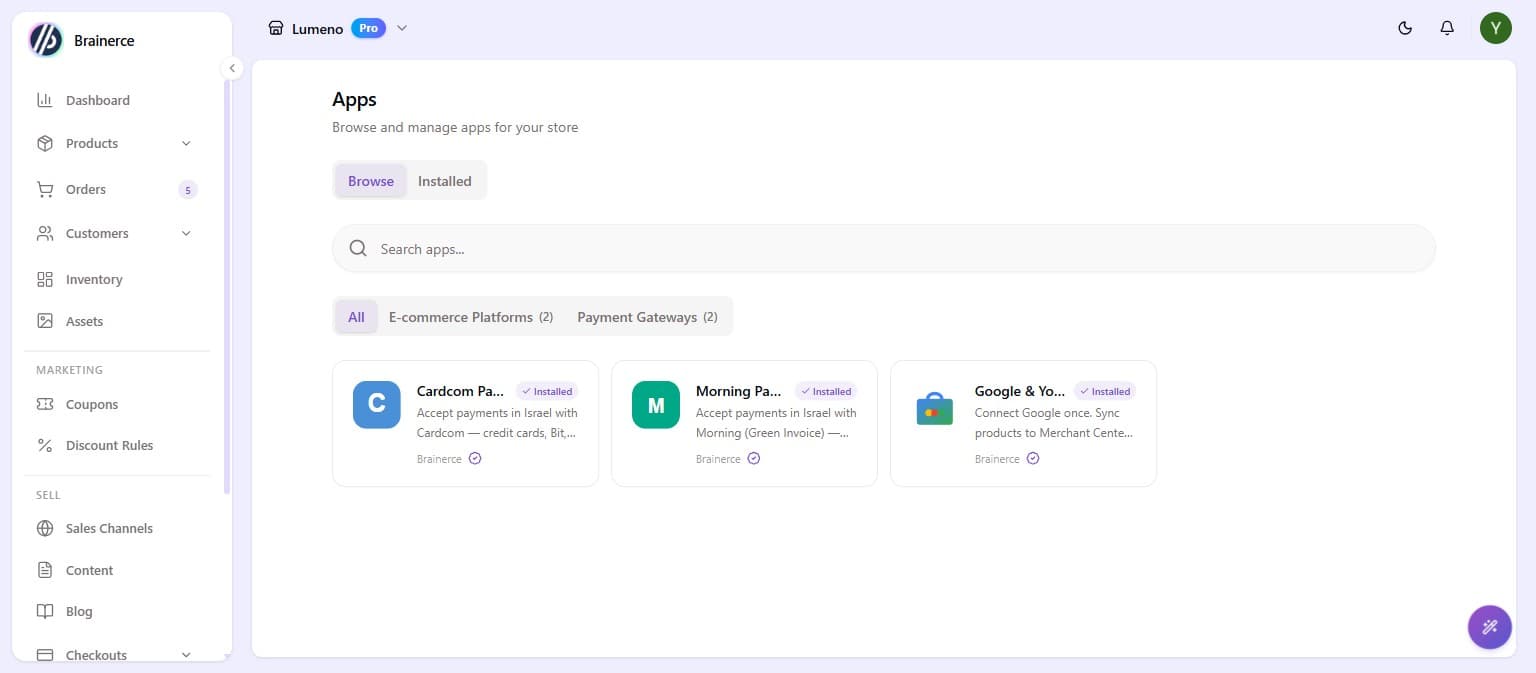
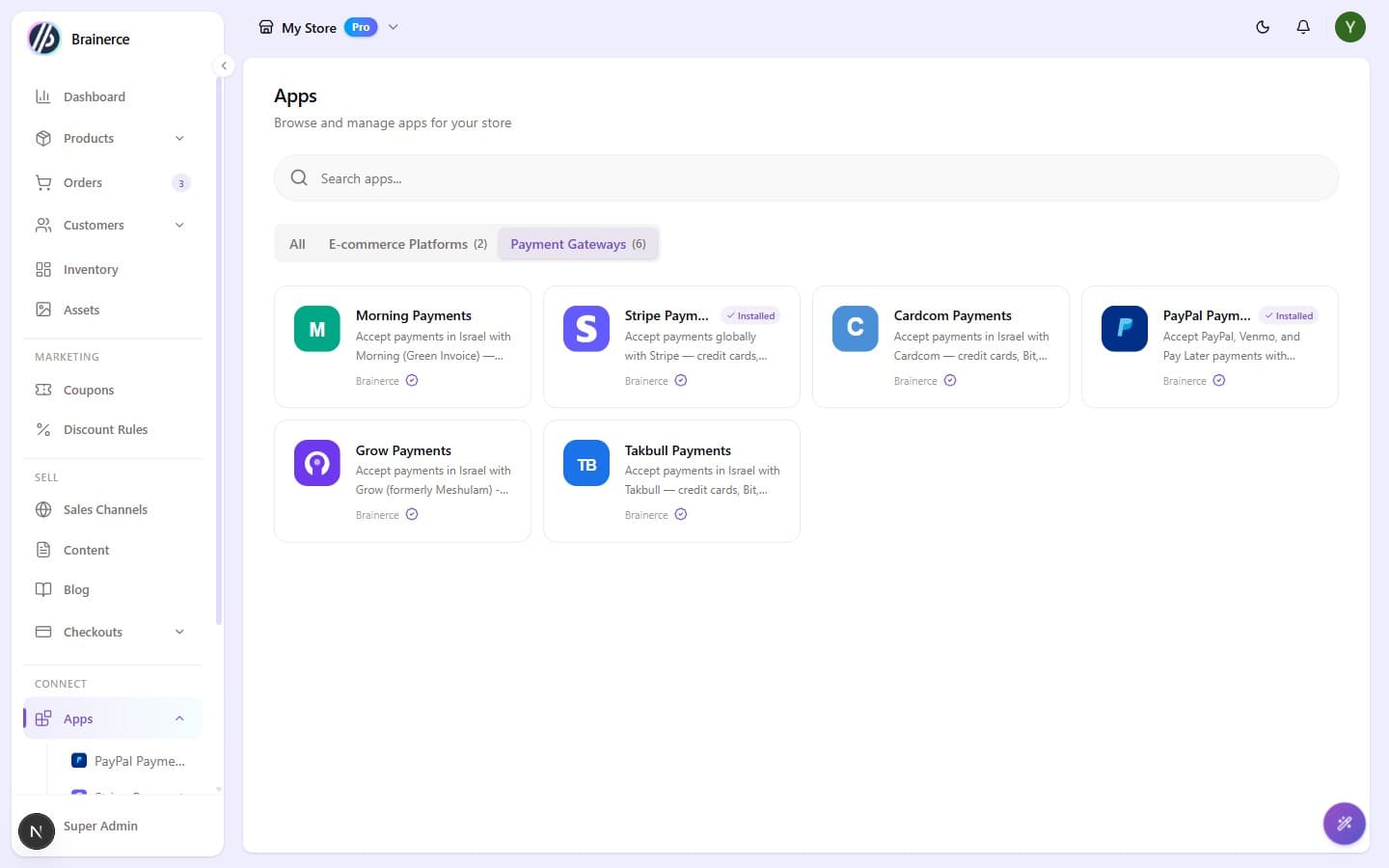
Every store sees every published gateway. Open Apps and check the Payment Gateways category: Stripe, Cardcom, Morning (Green Invoice), Grow, Takbull and Sola are all there.
PayPal, MAX and iCredit (ריווחית) are not available yet. All three are still in draft, so they do not appear in the marketplace and cannot be installed, whatever your plan. Do not plan a launch around any of them.
Country matters at the next step, not this one: a provider can only be switched on for a region whose countries it supports. So the question is never "is this gateway available to me" but "does it cover the region I'm selling into".
The marketplace list isn't filtered by your country, so changing your store country won't make a missing gateway appear. If a provider won't switch on where you need it, check the countries on that region under Settings → Regions, not your store country.
1. Connect a provider
- Open Apps in the sidebar and go to the Browse tab.
- Find the payment gateway you want and click its card.
- Click Connect.
- Finish the setup. Depending on the provider, you'll either be redirected to log in and authorize Brainerce, or asked to enter your account details (such as a terminal number or API key).
- When you return, the provider shows as Active on the Installed tab.
Already have an account with the gateway? Don't sign up for a second one. If a provider's setup screen leads with its own signup or application form, that is for merchants who don't have an account yet; it is not the only way in. Look for the fields that ask for your existing credentials (terminal number, API key, secret) and enter those instead. If you only see the signup form and no credential fields at all, that's a fault on our side rather than a rule about your account: email [email protected] and say which gateway, rather than opening a duplicate account with the provider.
2. Test mode vs. live mode
Most providers start in Test mode so you can place practice orders without moving real money.
- Open the provider from the Apps section of the sidebar, where each installed app appears by name.
- Switch Mode from Test to Live when you're ready to take real payments.
Keep a provider in Test while you're setting up, then switch to Live before you launch.
Check the badge: some providers connect straight into Live. "Starts in Test" holds when you pick Test yourself during setup. If you finished the provider's own application on their site and they issued you a real terminal, the app shows Live from the moment it connects, because that is what you have. Whatever the badge says is what your customers are being charged against, so read it once before you announce your launch.
Switching Live → Test is easy; switching back is not. Moving a connected provider to Test takes effect immediately and asks you for nothing. Moving it back to Live reopens the credentials form and will not proceed until you re-enter your terminal number, API key or secret. If the provider issued those to Brainerce directly (which is what happens when you complete their own application form rather than typing keys in yourself) you may not have a copy to re-enter, and your store cannot take real payments until you get one from the provider. If the badge says Live and you weren't expecting it, check with the provider that you hold your own credentials before you flip the switch, or email [email protected] first.
3. Make providers available in each region
A connected provider only appears at checkout for regions where you've enabled it. This is the most common reason a working provider doesn't show up for some customers.
- Go to Settings → Regions.
- Open the region you want to edit.
- In the Payment Providers section, turn on the providers that should serve that region.
- Click Save.
Only providers compatible with the region's countries and currency are shown.
Manage connected providers
Open an installed provider from the Apps section of the sidebar to:
- Set as default makes it the provider shown first at checkout.
- Reconfigure to re-enter credentials, including when switching from Test to Live.
- Disconnect drops the credentials but keeps the app installed.
- Uninstall removes it entirely.
To stop a provider appearing at checkout without uninstalling it, turn it off for the region in Settings → Regions.
Redirect or embedded payment page: your website chooses, not the dashboard
Some gateways can show their payment page two ways: by sending the customer to the gateway's own page and back (a redirect), or inside a frame on your checkout page (embedded). Which one a customer sees is decided by your website's code, within what the gateway supports. There is no setting for it in the dashboard, and there will not be one: only the website knows whether it has a frame to show the page in.
- Each gateway declares which modes it can serve. Cardcom and Sola are embedded only; Stripe, PayPal, Morning and Takbull are redirect only; iCredit and MAX can serve either.
- If your website asks for a mode the gateway does not offer, the customer gets the gateway's normal page. Nothing breaks and no payment is lost.
- If your website asks for nothing, the gateway's normal page is used, which is what happened before this existed.
- Whoever builds your website chooses this. If you want a different mode, ask your developer, or tell your AI builder: the option is called
preferredRenderTypeand is documented in the developer docs.
Selling in Israel
Seven of the gateways serve the Israeli market, and they differ in ways that matter more than the fee:
| Provider | Cards | Bit | Apple / Google Pay | Instalments (תשלומים) | Automatic VAT invoice |
|---|---|---|---|---|---|
| Cardcom | Yes | Yes | Yes | Yes | No |
| Morning (Green Invoice) | Yes | Yes | Yes | No | Yes |
| Takbull | Yes | Yes | No | Yes | Yes |
| Grow (formerly Meshulam) | Yes | Yes | No | Yes | No |
| MAX (מקס), not yet installable | Yes | No | No | Yes | Yes |
| iCredit (ריווחית), not yet installable | Yes | Not confirmed | Not confirmed | Yes | Yes |
| Stripe | Yes | No | Yes | No | No |
iCredit (ריווחית) is in draft, so you cannot install it yet
iCredit is the card gateway run by Rivhit (ריווחית). It is still in draft: it does not appear in the marketplace and you cannot connect it, whatever your plan. Do not plan a launch around it.
Here is what it will do when it opens up, so you can judge whether to wait for it:
- It works in shekels only (ILS). Selling in another currency needs a different gateway.
- The customer leaves your website to pay. iCredit shows its own payment page, the customer pays there, and they come back to your website afterwards. There is no card form embedded in your own checkout.
- תשלומים, saved cards and 3D Secure are supported, and you can refund from inside Brainerce.
- It issues a חשבונית or קבלה with every charge. See Invoices below.
- Bit, Apple Pay and Google Pay are marked "not confirmed" above because we have not yet run a live charge on a real iCredit terminal. Treat them as unavailable until this page says otherwise, rather than assuming they work.
What iCredit calls the credential you will need
When iCredit does open up, the one thing you paste into Brainerce is מזהה דף תשלום. It is worth knowing the name in advance, because searching your iCredit console for "טוקן", "מפתח" or "API" will not find it.
Inside your iCredit console: דפי תשלום then רשימת דפי תשלום, press ערוך on the payment page you want, and copy מזהה דף תשלום from הגדרות הדף.
Two things follow from that, and both surprise people:
- It belongs to a payment page, not to your business. If you have no payment page set up in iCredit yet, there is nothing to copy. Create one there first.
- It is both your identity and your password. Anyone holding it can charge through your terminal, so treat it the way you treat a password. Do not paste it into an email or a chat.
Trying iCredit will not need any of that. Test mode runs on a shared demo terminal that Brainerce holds, so you switch it on and get a working practice checkout without entering a credential at all. No real money moves and no real חשבונית is issued. You only need מזהה דף תשלום when you switch to taking real payments.
Refunds need a separate permission on an iCredit terminal too (הרשאת זיכוי). Being allowed to charge a card does not mean you are allowed to credit one. Ask iCredit to confirm the credit permission is switched on before you need it: 03-7466300, שלוחה 3. See The refund was declined by the credit card company.
MAX (מקס) refunds need an API password, and it is optional when you connect
MAX asks for a terminal number, an API key and an API password (סיסמת API). The first two are enough to take money. The API password is the only one that can give money back, and MAX will not accept the API key in its place for a refund, a cancellation or a charge to a saved card.
The field is optional in the connect form, so it is easy to skip. A MAX terminal connected without it charges cards perfectly and can never refund one. The order simply has no Create Refund button, with a note that says refunds are not available for this provider and links nowhere. Nothing at setup tells you this, and no test payment fails.
On a test connection there is never a password. The shared MAX test terminal is issued none, so refunds are always unavailable in test mode, whatever you do. That is expected.
The fix is to open your MAX installation under Apps, choose Reconfigure, and re-enter your credentials with the API password included. See There is no Create Refund button on a MAX order. MAX is still in draft and cannot be installed yet, so this applies from the day it opens up rather than today.
Refunds need their own permission
Being able to charge a card does not mean you can refund one. Israeli acquirers grant the credit permission (הרשאת זיכוי) separately from the charge permission, and a terminal is often provisioned with only the charge side. Nothing warns you at setup: payments work, and the gap only shows up the first time you try to refund, as a refund declined by the credit card company. Ask your gateway to confirm the credit permission is enabled before you need it. See The refund was declined by the credit card company.
On MAX there are two independent things to get right, and they have opposite symptoms. No API password saved means there is no refund button at all, and you fix that yourself under Apps in a minute. No credit permission on the terminal means the button is there, you press it, and the credit card company refuses the credit, and only MAX can fix that. A MAX terminal can be short of both, and sorting one out does nothing for the other.
A refund you take in the gateway's own dashboard does not reach Brainerce
This one is worth knowing before you pick a gateway, because it never comes up until the first refund.
Only Stripe, PayPal and Grow report a refund back to us. Refund a charge in one of those and Brainerce marks the order refunded by itself.
Cardcom, iCredit, MAX, Morning, Sola and Takbull report nothing. Credit a customer in the Cardcom dashboard, or in your iCredit, MAX, Morning, Sola or Takbull screens, and the money genuinely goes back while Brainerce never hears about it: the order still says paid, the promo code the customer used stays spent, their lifetime spend is unchanged and their loyalty points stay with them. There is no sync and no catch-up job. So with those six, always issue the refund inside Brainerce and let it call the terminal for you. If you already refunded outside, see The money went back but the order still says paid.
Morning is the awkward case by design. Morning's API has no refund at all, so Brainerce hides the Create Refund button on a Morning order and points you at Morning's dashboard instead. On Morning that is the refund you are forced to make outside, every time, and it is also one Brainerce will never learn about, so you always record it by hand afterwards. If refunds are frequent for you, weigh that against Morning's automatic invoice before you choose it.
A MAX terminal with no API password lands you in the same place by accident, and the note on the order does not even give you a dashboard link. That one is worth checking before you conclude MAX cannot refund: see MAX (מקס) refunds need an API password above.
Invoices
Brainerce does not issue tax invoices. There is no invoice document, no numbering, and nothing sent to the customer after an order beyond the order-confirmation email.
If you need a חשבונית מס issued automatically, and in Israel you generally do, connect a provider that issues one: Morning (Green Invoice) or Takbull. The invoice is then produced by that provider, under your account with them, not by Brainerce. With any other gateway you are invoicing separately, outside the platform.
MAX also issues invoices, but you cannot install it yet. It is still in draft and does not appear in the marketplace. If automatic invoicing is why you were choosing MAX, use Morning or Takbull instead.
iCredit (ריווחית) issues a חשבונית or קבלה too, and you cannot install it yet either. It is also still in draft. When it opens up, iCredit produces the document itself as part of the charge, under your own account with Rivhit, and the document number and a link to it appear in the invoice column of your orders list. If automatic invoicing is why you were waiting for iCredit, use Morning or Takbull today.
Which document iCredit issues is set inside iCredit, not in Brainerce. Whether you get a חשבונית מס/קבלה or a קבלה בלבד follows the way your terminal is configured at Rivhit, which usually follows whether you are עוסק מורשה or עוסק פטור. There is no setting on our side that changes it, so if you need a different document, ask Rivhit to change it on your terminal.
Bit
Bit is supported by Cardcom, Morning, Takbull and Grow. It is not a separate app you install; it comes with the gateway, so pick a gateway that offers it rather than looking for Bit in the marketplace.
Do not wait for iCredit (ריווחית) if you need Bit. iCredit is in draft and cannot be installed, and we have not confirmed that Bit works through it. Choose one of the four gateways above instead.
Paying with a gift card
A gift card is a means of payment too, and it does not come from this page. It is not a provider, there is nothing to install, and it is not enabled per region.
- A gift card can pay part of an order. The customer types the code, the card covers what it can, and they pay the rest through one of the providers above. You still need at least one provider connected.
- A gift card can pay all of an order. When the card covers the whole total, no provider is involved and nothing is charged.
- You still issue every gift card by hand from the dashboard. A customer cannot buy one on your website.
- Gift cards are still in rollout, so there is no Gift cards entry in your sidebar yet.
- The code box at checkout is part of your website and has to be built, like the coupon field. See a feature you turned on is not showing on your website.
Why can't my customers pay?
| Symptom | Likely cause and fix |
|---|---|
| No payment options at checkout | No provider is enabled for that customer's region. Check Settings → Regions. |
| Provider connected but checkout still fails | Provider is still in Test mode. Switch it to Live. |
| Provider connected but never offered | It isn't enabled for the customer's region. Check Settings → Regions. |
| "Currency not supported" error | The checkout currency isn't supported by that provider. Use a supported provider. |
| Provider shows as Pending / not Active | The connect step didn't finish. Reconnect from Apps. |
| Payments stopped right after the store was transferred to you | Payments are paused from the moment a store transfer is accepted, and they stay paused until the new owner connects their own payment provider and it shows as Active. A provider the previous owner left connected does not count, and neither does installing without connecting, or waiting. See Payments are paused after a store transfer. |
What's next?
Still stuck? Email [email protected] and we'll help you get paid.