 Brainerce Help
View and edit a customer profile
Find a customer, see their order history and lifetime value, edit their details, and organize them with tags.
Every person who buys from you gets a customer record. The Customers section is where you look them up, review their history, and keep their details tidy.
Find a customer
- Open Customers in the sidebar.
- Search by name, email, or phone in the search box.
- Narrow the list with filters:
- Marketing consent: Consent given or No consent. This one matches on the consent tick box alone, not on whether a campaign can actually reach the address. The Marketing column is what answers that.
- Account Status: Registered or Guest.
- Sales Channel finds only customers who shop on the storefront you pick.
- Lifetime Spend finds customers above or below an amount you set.
- Orders filters by how many orders they've placed.
- Last Order finds people who ordered within the last N days, or who did not order in N days.
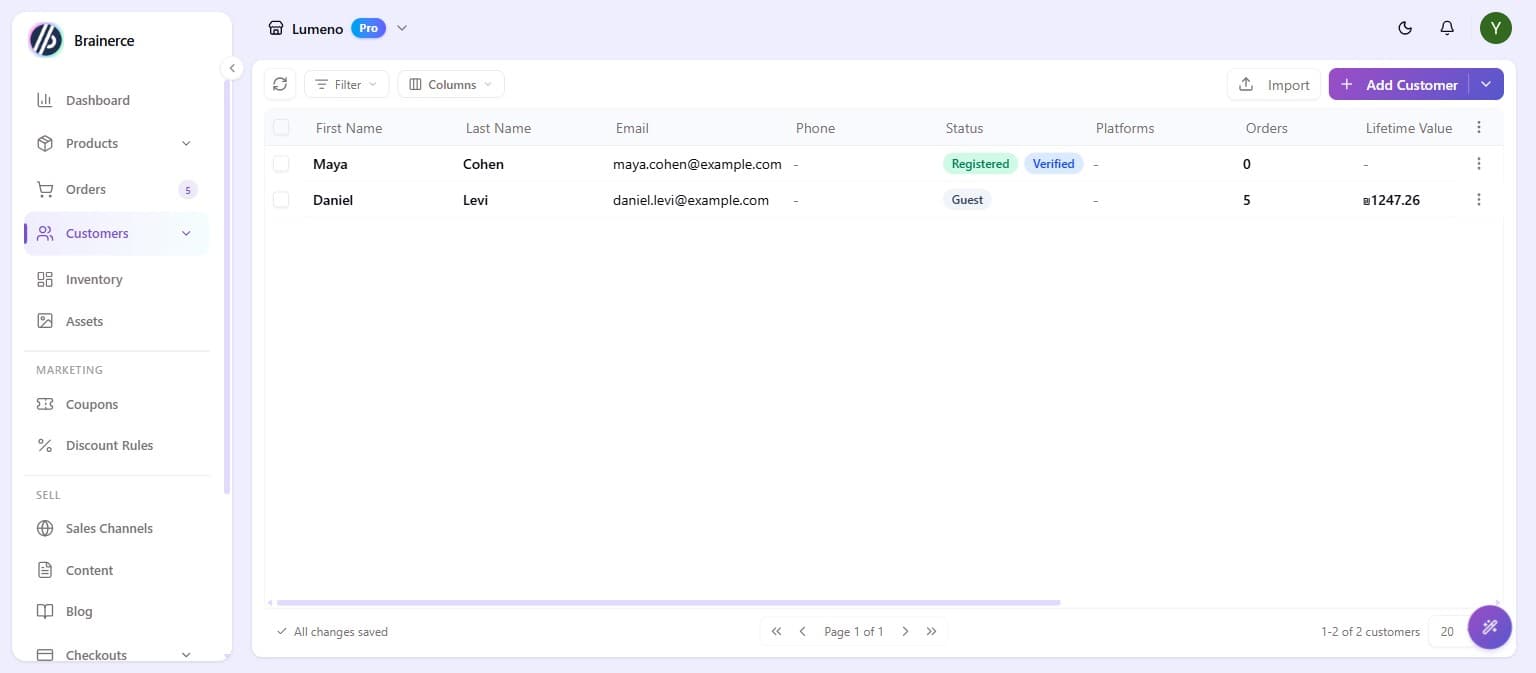
- Click any row to open that customer's details.
What the Marketing column means
The Marketing column in the Customers list answers one question: can a campaign actually reach this person? That is not the same as the consent tick box on their record. An address can be ticked and still be unmailable, and this column is the one that tells the truth. It sits next to Status, near the start of the list. If you have dragged your columns into your own order in the past, it stays where you left it instead: drag it where you want it, or use Reset all in the Columns panel to go back to the standard order.
| Badge | What it means | Can a campaign reach them? |
|---|---|---|
| Subscribed | They opted in and nothing blocks the address. | Yes |
| Not subscribed | No consent yet: never opted in, or sent a confirmation email they haven't clicked. | No |
| Unsubscribed | They opted out of marketing. | No |
| Bounced | Mail to this address hard-bounced. | No |
| Marked as spam | They reported one of your emails as spam. | No |
| Blocked | Suppressed by hand, or unsubscribed and since bounced or reported, no way back. | No |
Ticking the consent box on an unsubscribed customer does not make them mailable again. The badge stays Unsubscribed and campaigns keep skipping them. Only their own click on a confirmation link brings them back, which is covered in Can a customer re-subscribe after unsubscribing?. This is the most common reason a campaign reports 0 recipients for someone who looked subscribed.
The Marketing consent filter only knows two states. It is named for what it does: it filters on the consent tick alone, so a customer who unsubscribed after you ticked their box turns up under Consent given while their badge reads Unsubscribed. When the two disagree, the badge is the one that decides whether mail goes out. There is no "only people I can actually mail" filter to pick instead.
The Marketing card on a customer record
Open any customer and the Marketing card shows the same badge the list does, with a line under it saying what would change it. The consent switch sits below the badge, and on a suppressed address the card says outright that turning it on will not make the address mailable again.
Read the badge before you touch the switch. The switch records that you believe this person consented. It does not undo an unsubscribe, a bounce, or a spam report, because those are the recipient's own actions and only the recipient can reverse them. There is no button here that emails an unsubscribed customer to ask them to opt back in, and that is deliberate: mailing someone who opted out is exactly what the opt-out forbids.
What's in the customer record
Clicking a customer opens their record as a panel over the list. There is no separate profile page, and everything below is editable in place.
| Section | What it shows |
|---|---|
| Customer Information | Email (with a Verified badge), phone, and name |
| Marketing | Whether a campaign can reach this address, plus the consent switch |
| Birthday | Month and day, no year. Feeds the birthday gift email |
| Addresses | Saved shipping and billing addresses |
| Account Status | Registered vs. guest, plus created and last-updated dates |
| Orders | Total orders, lifetime value, and last order date |
| Connected Platforms | The customer's id on a connected platform app, when one is installed |
| Came from | The storefront this customer first arrived through. Shown on the customers list, not editable |
| Sales channels | Every storefront of yours this customer shops on |
| Tags | Labels you add to group and segment customers |
Connected Platforms and Sales channels are not the same thing. Connected Platforms is about outside systems: the customer's id on a connected platform app, when one is installed. Sales channels is about your storefronts: which of the sites you built on Brainerce this person shops on.
Customers are never imported from Shopify or WooCommerce. The Migration Tool brings across products, their categories, and orders, and deliberately leaves customer records behind, so a migrated store starts with an empty customer list. See Import from another platform.
Which sales channels a customer belongs to
One customer record covers your whole store, so the same person can shop on several of your storefronts and still be a single customer, and you will not get a duplicate record per channel. That is what the Sales channels column on the list, and the channel picker in the record, show you.
A channel is added to a customer automatically the moment they are seen on it: when they register, sign in (including with Google), or complete a checkout there. Nobody has to tag them by hand.
You can add or remove channels yourself in the record's channel picker. Removing one is a correction, not a block: it does not stop that person from buying on that storefront, and the channel comes back on their next sign-in or order there. There is no way to bar a customer from a sales channel.
Customers who have never bought and never signed in on any channel show no channels at all. That is normal, for example someone you added here by hand, or imported from a file.
Where a customer came from
Came from is the first storefront a customer ever arrived through. It is recorded once, at the moment they first register, sign in or check out, and then left alone, and later activity on other channels never changes it, which is what makes it useful for "which storefront is winning me customers".
It is empty, showing Unknown, whenever nobody ever saw where they came from:
- You added the customer here in the dashboard.
- You imported them from a CSV or JSON file.
- They shop on a storefront connected by store ID rather than as a sales channel.
- They existed before Brainerce started recording this.
You cannot set or correct it from the dashboard. There is no Came from field on the customer record. It is evidence of something that happened, not a setting, so the only way to write it is the API, and for most stores the right answer to a wrong or missing value is to leave it as Unknown rather than invent one.
Where you can see it: on the customers list, the channel badges mark the origin channel, and the list filters by it. Came from is not the same as the channels a customer shops on, which you can change.
Edit a customer's details
The record opens ready to edit; there is no separate Edit button. The first section is Contact Information; change what you need and click Save.
You can edit far more than the basics here:
- Name, phone and marketing opt-in are the everyday fields.
- Birthday, month and day, with no year field, so no age is stored. It is what the birthday gift email goes by, and the gift still only reaches customers who accepted marketing.
- Email: changing it changes the address they sign in and receive mail at.
- Password. Set one to convert a guest into a registered customer, or clear it to turn a registered customer back into a guest.
- Role is a free-text segment your storefront code can read through the SDK to unlock role-gated features (wholesale pricing, early access). It is never shown to the customer.
- Sales channels are which of your storefronts they shop on. Channels are added automatically when the customer is seen on them, so a channel you remove here comes back on their next sign-in or order there.
- Tags, Addresses, and platform sync.
You can also open the same record from the list's ⋯ menu with Edit in form.
Manage addresses
In the Addresses card, click + Add Address (or the pencil icon to edit). Fill in the address fields, optionally give it a Label (e.g. Home, Work), and tick Set as default address if it should be the default.
Organize with tags
Use the Tags card to label customers, for example VIP, Wholesale, or Newsletter. Type to find or create a tag; changes save automatically. Tags are one of two ways to segment customers. The other is Role, a free-text field your storefront can read via the SDK. Use tags for how you group people, and Role for what your storefront code should do differently. There is no free-text notes field.
Add a customer manually
Customers are created automatically when someone checks out, but you can also add one yourself:
- On the Customers list, click + Add Customer.
- Enter the email (required), plus name, phone, birthday (month and day, no year), any tags, and optionally a Role.
- (Optional) Set a password to create a registered account, or leave it blank to add the customer as a guest. Then click Create Customer.
You can also Import customers from a CSV or JSON file from the toolbar. Birthdays travel with the file in two whole-number columns, birth_month (1 to 12) and birth_day.
Export works differently: tick the customers you want and the export buttons appear in the bar at the bottom of the screen. It exports only the rows you selected, and both the CSV and Excel choices download a .csv file. The export carries the birthday in the same birth_month and birth_day columns the import reads, so an export you edit and re-import keeps every birthday.
Delete a customer
Open the row's ⋯ menu and choose Delete Customer, or tick several rows and use Delete Customers in the bulk bar. This permanently removes the customer and their associated data and can't be undone.
Some customers can't be deleted, and Brainerce will say why
Delete is refused, with a message naming the reason, in three cases. None of them is an error you can retry your way past.
- They have an active recurring payment schedule. Cancel the schedule first. Until you do, the payment provider is still holding their card, and deleting the customer here would leave nothing on our side that could ever cancel it.
- They hold a paid loyalty membership that is still billing. Same reason, same fix: cancel the membership first. A membership marked past due counts as still billing, because it is retried daily rather than ended.
- They have been charged for a paid loyalty membership at any point in the past. This one is permanent. Those charges are money you actually took from that person, and Brainerce keeps them the same way it keeps orders, payments and gift card history: they are your financial record, and a delete button does not get to erase them. It applies even when the membership was cancelled long ago.
In that last case the customer record stays. You can still edit their details and unsubscribe them from all marketing, but there is no way to remove the row, and no setting that changes this.
What's next?
Need help with a customer record? Email [email protected].