 Brainerce Help
Adjust stock
Set a product or variant's stock level, and choose whether Brainerce tracks its quantity.
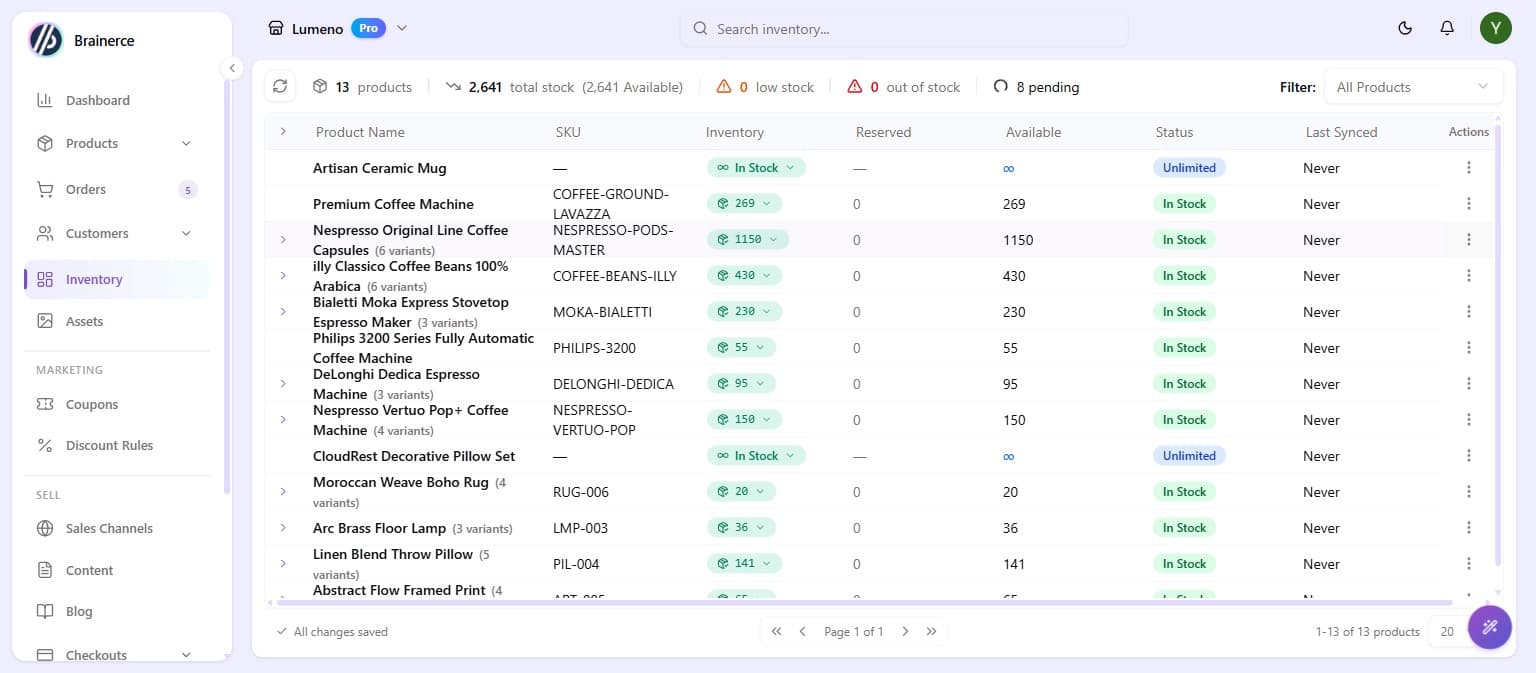
The Inventory page is where you see and update stock across your whole catalog. Open it from Inventory in the sidebar.
No Inventory page at all? Stock tracking is a module, and stores set up to sell only digital goods or services start with it switched off, which removes the whole Inventory section, not just a sidebar link. Turn it on under Settings → Modules.
Update a stock level
The same stock popover opens from the Inventory page and from the Products table, on the inventory cell of any row. Both write the same change.
- Open Inventory (or Products). Products with variants expand to show each variant on its own row.
- Click the inventory cell (the stock badge) for the product or variant you want to change.
- In the popover, make sure Manage Inventory is on. Then either:
- Set total: type the new count you have on hand. A shipment of 30 arrives and you had 5: enter 35.
- Adjust by: type the change instead: +30 for a delivery, -2 for breakage. The popover shows the current count and what it becomes before you save.
- Pick a reason if you want the movement history to say what happened (received shipment, damaged goods, return from customer, return to supplier, stock count, manual correction, or your own text). Leave it blank and the history records which screen the edit came from.
- Click Save.
Update every variant at once
A product with variants opens a popover that lists each variant with its own toggle and quantity. Above the list, All tracked variants applies one number to every variant that has Manage Inventory on:
- Choose Set total or Adjust by, type the number, and click Apply. Every tracked variant's quantity fills in, and each row shows its before and after. Variants with tracking off are skipped.
- Change any single variant's quantity by hand if one size differs.
- Pick one reason. It is saved on every variant's movement.
- Click Save. The button says how many variants will change, and only those are written.
Apply fills the fields, it does not save. Nothing changes on the store until you click Save; close the popover to discard.
Add or remove units from the row menu
The popover above covers most edits. The row menu opens a larger dialog with the same Adjust by and reason, plus the product's alert threshold:
- On the product's row, open the actions menu (the three dots at the end of the row).
- Choose Update stock.
- Switch to Adjust by and type the change: +30 for a delivery, -2 for breakage. The dialog shows the current count and what it becomes before you save.
- Pick a reason: received shipment, damaged goods, return from customer, return to supplier, stock count, manual correction, or your own text.
The reason is saved with the change and shows up in the movement history below, so a count that looks wrong later can be traced instead of guessed at.
The same dialog holds the product's alert threshold, the level that counts as low for this one product. See set a threshold for one product.
This dialog is for simple products only. A product with variants keeps its stock on each variant, so use the stock badge on the row and set each variant there. A kit has no count of its own and is not offered the dialog at all.
See who changed stock, when, and why
Open the row's actions menu and choose Stock movements for the last 20 changes to that product: what the count went from and to, how long ago, and the reason if one was given. Reservations and fulfilments from customer orders appear here too, not only your own edits.
Variant rows have the same menu item, and it shows the movements for the whole product, variants included.
A kit has no movement history, because it holds no count. Look at the movements of the products inside it instead.
Stock tracking modes
The Manage Inventory toggle controls how Brainerce handles availability:
| Mode | Behavior |
|---|---|
| Manage Inventory on | Brainerce tracks the count and reduces it as orders come in. |
| Off → In Stock | Always available, no count is kept (good for made-to-order). |
| Off → Not for Sale | Can't be purchased, and collects no back-in-stock waitlist. |
Not for Sale products sit outside the stock filters. Like kits, a product you switched off is in none of the In stock, Low stock or Out of stock buckets, and it is not added to the Out of stock counter. It was your decision, not a shortage, so there is nothing to reorder. Its units still count in Total stock, because you are still holding them, but not in the available figure beside it, because nobody can buy them.
Sold out is not the same as Not for Sale. If the product is coming back and you want shoppers to ask about it, leave Manage Inventory on and set the quantity to 0. Switching the toggle off and picking Not for Sale blocks purchase but also blocks the back-in-stock waitlist, because there is no stock count for Brainerce to watch.
Kits (gift boxes) have no stock of their own
A kit has no quantity you can type. Its stock cell is not editable, and the Inventory page shows it blank rather than a number.
That is on purpose. How many kits you can sell is worked out from what is inside them: whichever component runs out first sets the limit. A gift box holding one bottle and two glasses, with 10 bottles and 12 glasses on hand, is 6 boxes, because the glasses go in pairs. Type a number onto the kit itself and it would be a second, frozen count that never moves when a bottle sells, so Brainerce does not let you.
To change how many kits you can sell, change the stock of the products inside it. Open Inventory, find those products, and set their quantities the normal way. The kit follows on its own.
The same applies to every other route in: Bulk Set Stock skips kits in your selection and tells you it did, the inventory CSV importer reports a kit row as an error rather than importing it, and the API and AI assistant refuse a stock write to a kit with an explanation. Kits also sit outside the In stock, Low stock and Out of stock filters entirely. This page holds no count for them, and a filter that guessed would be worse than one that abstains.
Available, Reserved, and Total
When tracking is on, the popover shows:
- Available is what customers can still buy.
- Reserved is units held in open carts or unfulfilled orders.
- Total is Available plus Reserved.
Stock is tracked per variant, so each size/color can have its own count.
A product is only "unlimited" when every variant is. Mix one made-to-order size in with tracked ones and the product is still tracked: its row shows the total of the sizes you do count, and the unlimited size adds nothing to it rather than wiping the number out.
Updating a lot of stock at once
Two faster paths than editing rows one at a time, both on the Inventory page:
Import a CSV. The Inventory page has its own importer taking just two columns: SKU and Stock. It matches both product and variant SKUs, which makes it the right tool after a stock count.
This is not the product importer. The one under Products cannot update stock on an existing product. See Bulk import from CSV.
Bulk Set Stock. Select several rows and set them all to the same quantity in one action.
You can also export the current stock levels, which gives you a correctly-shaped file to edit and import back. The Export button in the toolbar covers your whole catalog, not just the page on screen, and follows the search box and channel filter if you have either set. To export only certain products, tick their rows and use Export in the selection bar instead.
Reserving stock per sales channel
The Channel policy column controls how much of an item each sales channel may sell. Use it to hold stock back for one channel, keeping a buffer for your own storefront while a marketplace sells the rest, rather than letting whichever channel sells first take everything.
What's next?
Need help with inventory? Email [email protected].