 Brainerce Help
Customize email templates
Edit the automatic emails customers receive, send from your own domain, and check delivery.
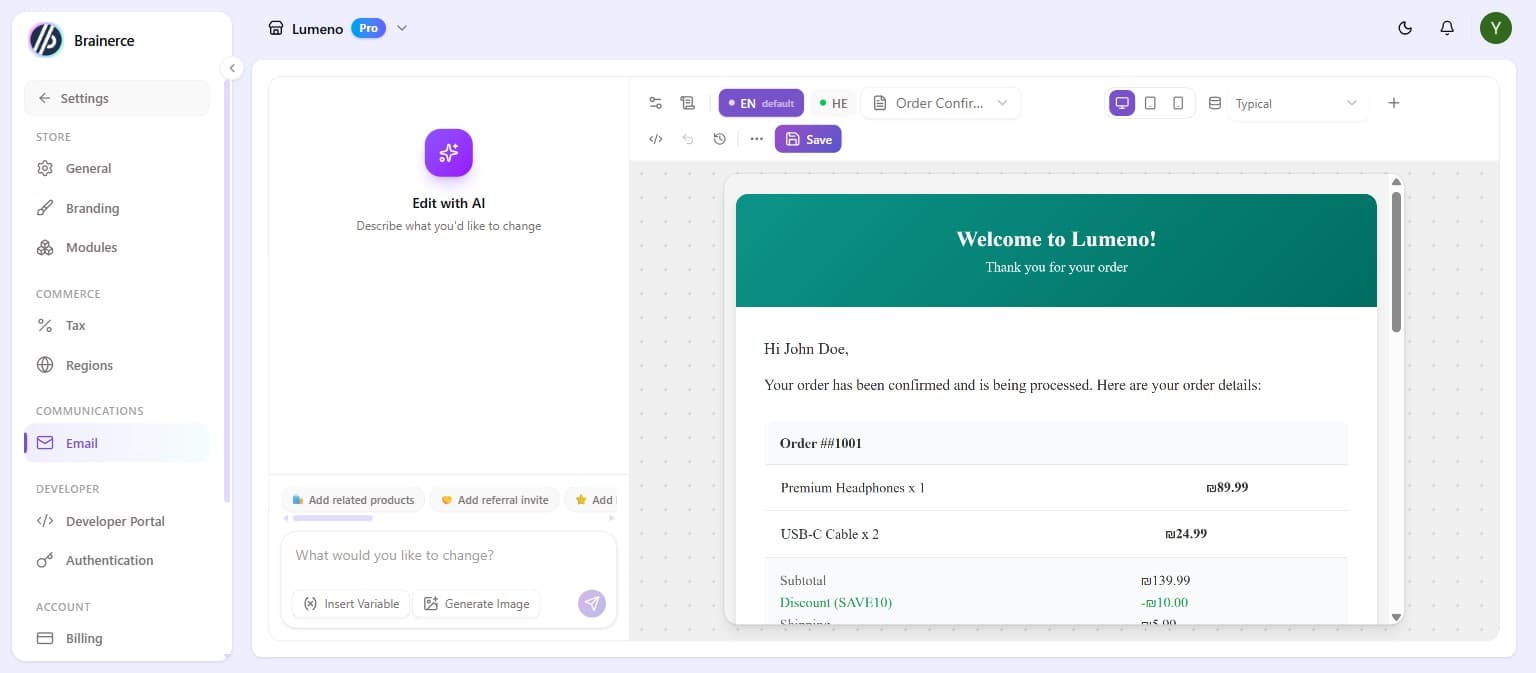
Brainerce sends transactional emails automatically: order confirmations, shipping updates, refunds, and more. Customize them under Settings → Email.
The emails you can edit
The email editor covers your store's transactional emails, including:
- Orders: order confirmation, shipped, cancelled, completed, refunded
- Customers: welcome, email verification, abandoned cart, inquiry confirmations and replies
- Team & store: team and store invitations, role changes
- System: low-stock alerts, export-ready notifications
Edit a template
- Go to Settings → Email and pick a template.
- Edit it in the visual editor. Drag in blocks, insert variables (like the customer's name or order number), and preview on desktop, tablet, or mobile. You can also switch to code view or use the AI chat panel to make changes by describing them.
- Click Save. Each saved change is versioned, so you can restore an earlier version from the history.
What address do my emails come from?
Open Settings → Email, click Email Settings in the toolbar, and look under From name. The line there is exactly what a customer sees in their inbox.
Until you verify a domain of your own, it reads Your Store <[email protected]>. That is a Brainerce address, and every store on Brainerce sends from it.
Why sharing an address with other stores costs you
Gmail, Outlook and Yahoo decide whether an email reaches the inbox or the spam folder largely by looking at the address it came from and how people have reacted to that address before. While your store sends from the shared Brainerce address, that history is not yours: it is the combined history of every store on the platform. One merchant emailing a bought list can push your order confirmations into spam, and there is nothing you can do about it from your side.
Verify your own domain and you leave that pool. The reputation becomes yours alone, built only by the way you send, and the email says it is from you rather than from us.
Send from your own domain
- Go to Settings → Email and click Email Settings in the toolbar.
- Under Custom Email Domain, click Add Domain and enter the domain your website is on, such as
yourstore.com. Nohttp://and nowww.. - You get a short list of records. Copy each one into your domain host, meaning the account where your website address is managed (GoDaddy, Cloudflare, Namecheap, your web developer's panel, wherever you bought the domain).
- Come back and click Check Status. Your records are checked automatically as well, so if it still says Pending, wait rather than repeating the setup.
The whole job is copy and paste. Nothing is being redirected and nothing is being switched over.
What adding these records does not do
It is worth being blunt about this, because it is the part merchants worry about:
- Your website is not touched. These records only authorise sending. Your site stays exactly where it is and keeps loading the same way.
- Your existing mailboxes are not touched. If
[email protected]runs on Google Workspace, Microsoft 365 or anything else, it keeps working unchanged. - Your customer list is not touched. Nobody is moved, resubscribed or unsubscribed, and nobody's marketing consent changes. Verifying a domain changes the address your emails leave from and nothing else.
- Nothing breaks while you wait. Until verification passes, your emails keep going out from the Brainerce address exactly as before. There is no window where mail stops.
DNS changes can take up to 48 hours to reach everyone, though it is usually much faster.
Verifying does not give you a mailbox
Verification authorises sending, and only sending. It does not create a mailbox: nothing is delivered to the [email protected] address your mail now comes from, and your own mail provider (Google Workspace, Microsoft 365, whoever handles your @yourstore.com mail) has never heard of that address. Replies reach you through the Reply-To address instead, which is why it needs to be one you actually read.
Can I choose the address, or use more than one domain?
No on both counts. The sending address is always notifications@ on the domain you verified, and it is not something you can change. A store sends from one verified domain: if you add a second, mail goes out from the one verified most recently. You can also only claim a domain once across all of Brainerce, so a domain another store has already verified cannot be added.
Email logs
The Logs button in the Settings → Email toolbar shows every message the store has sent and what happened to it. Six statuses:
| Status | Meaning |
|---|---|
| Queued | Accepted, waiting to send. |
| Sending | In flight. |
| Sent | Handed to the mail provider. |
| Delivered | The receiving server accepted it. |
| Bounced | Rejected: bad address, or the receiving server refused it. |
| Failed | We couldn't send it at all. |
This is where to look when a customer says they never got a confirmation. Sent without Delivered points at the recipient's side; Bounced usually means the address is wrong; a run of bounces is worth fixing quickly, because it damages your domain's reputation and starts affecting everyone else's mail too.
Unsubscribe links: marketing only
Two kinds of email leave your store, and the unsubscribe link belongs to only one of them.
Marketing email, meaning campaigns and abandoned-cart recovery, exists to promote a sale, so the law requires a working opt-out. Brainerce adds it for you: a footer link plus the one-click unsubscribe header Gmail and Yahoo expect from bulk senders. You don't have to add anything, and the send is blocked rather than delivered without one.
Transactional email (order confirmations, shipping updates, refunds, password resets, team invitations) is exempt, and an unsubscribe link there does real damage. It offers the customer an opt-out you can't honor (you still have to send the next receipt), and a click opts them out of all your marketing, every future campaign and abandoned-cart email, when all they wanted was fewer receipts. Their order emails keep arriving regardless, so nothing looks wrong to them while you quietly lose a subscriber, and only the customer themselves can undo it. See Can a customer re-subscribe?. So these templates carry no unsubscribe link, and the editor flags one if it finds it.
If you want an unsubscribe link in your own footer design, point it at the {{unsubscribeUrl}} variable and wrap it so it hides itself on transactional mail:
{{#if unsubscribeUrl}}<a href="{{unsubscribeUrl}}">Unsubscribe</a>{{/if}}Never point it at # or a URL you typed yourself. {{unsubscribeUrl}} is replaced at send time with a signed link that actually works. Anything else looks live and does nothing, which is how a customer who wants out ends up clicking "report spam" instead.
Set the name customers see
Open Settings → Email, click Email Settings in the toolbar, and set From name to whatever you want customers to see, usually your store's name. Under the field you can see the full From line the email will carry, name and address together.
Set Reply-To in the same place. The sending address itself is notifications@ on whichever domain you send from and is not something you choose, and it is send-only either way. See When a customer replies below before you point customers at it.
When a customer replies to an email
Set a Reply-To address under Settings → Email: a real mailbox you read, such as [email protected]. Every automatic email carries it, so a customer who hits Reply reaches you.
Leave it empty and Brainerce falls back to the account owner's email address. What it never falls back to is the address the mail was sent from. notifications@… is send-only on the Brainerce domain and on your own verified domain alike: a reply to it is delivered nowhere, the customer gets a bounce, and you never learn they wrote.
Brainerce has no inbox of its own. Replies go to whichever mailbox your reply-to address belongs to (your Gmail, your helpdesk, your support alias) and are not shown anywhere in the dashboard.
Choose which emails go out
A single Email Notifications master switch at the top of the settings panel turns all transactional email on or off at once (it shows an "X of Y enabled" count). Below it, turn individual emails on or off. Each shows whether it's sent to the customer, the store owner, or both. If your store has multiple languages, each template can be authored per language.
Test, reset, and track
- Send Test Email (from the ⋯ menu) sends the current template to an address you choose.
- Reset to default (⋯ menu) restores the original template; Delete removes a custom template.
- Email Logs shows every message and its status (Sent, Delivered, Bounced, or Failed) so you can confirm delivery.
Your logo and brand colors are applied to emails automatically. See Branding and appearance.
What's next?
Need help with email? Email [email protected].