 Brainerce Help
Categories & tags
Build your catalog hierarchy with categories and use tags for cross-cutting labels. Both are assigned to products from the same editor.
Categories and tags organize your catalog in complementary ways. Categories are hierarchical: a product lives at a specific place in your menu tree. Tags are flat labels that cut across categories for collections, filters, and promotions.
Categories at a glance
A category answers: "where in my shop does this product live?" They form a tree:
Electronics
  ├── Phones
  │   ├── Smartphones
  │   └── Accessories
  └── Laptops
Each category gets its own storefront landing page (/categories/phones), breadcrumb trail on product pages, and optional navigation menu entry.
The categories list
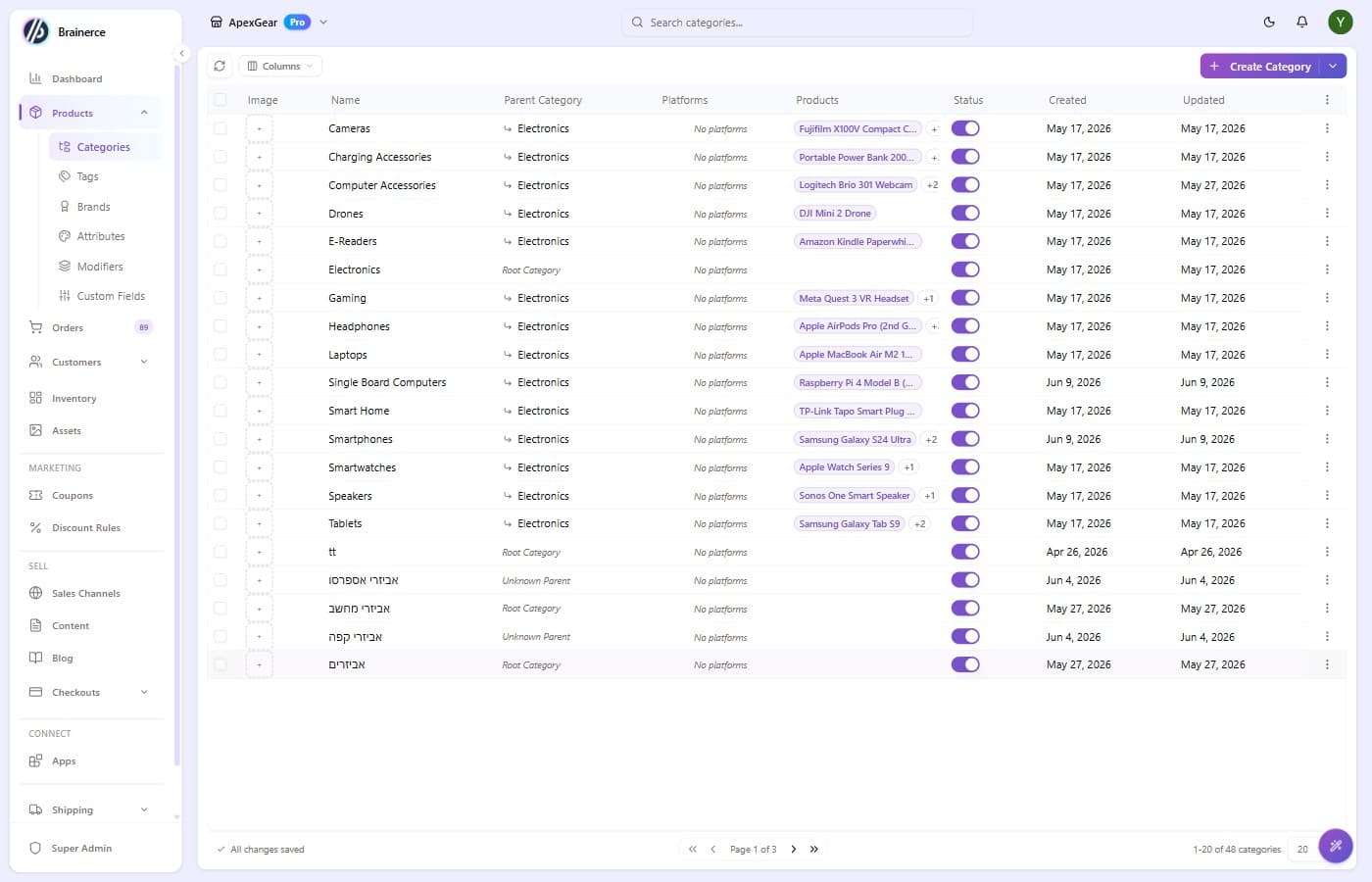
Go to Products → Categories in the sidebar to see all your categories with Name, Parent, Active status, Tax setting, image thumbnail, and which platforms each is published to.
Don't see it in the sidebar? Categories is a module, and it can be switched off for a store; some store types start with it off. Turn it back on under Settings → Modules.
Creating a category
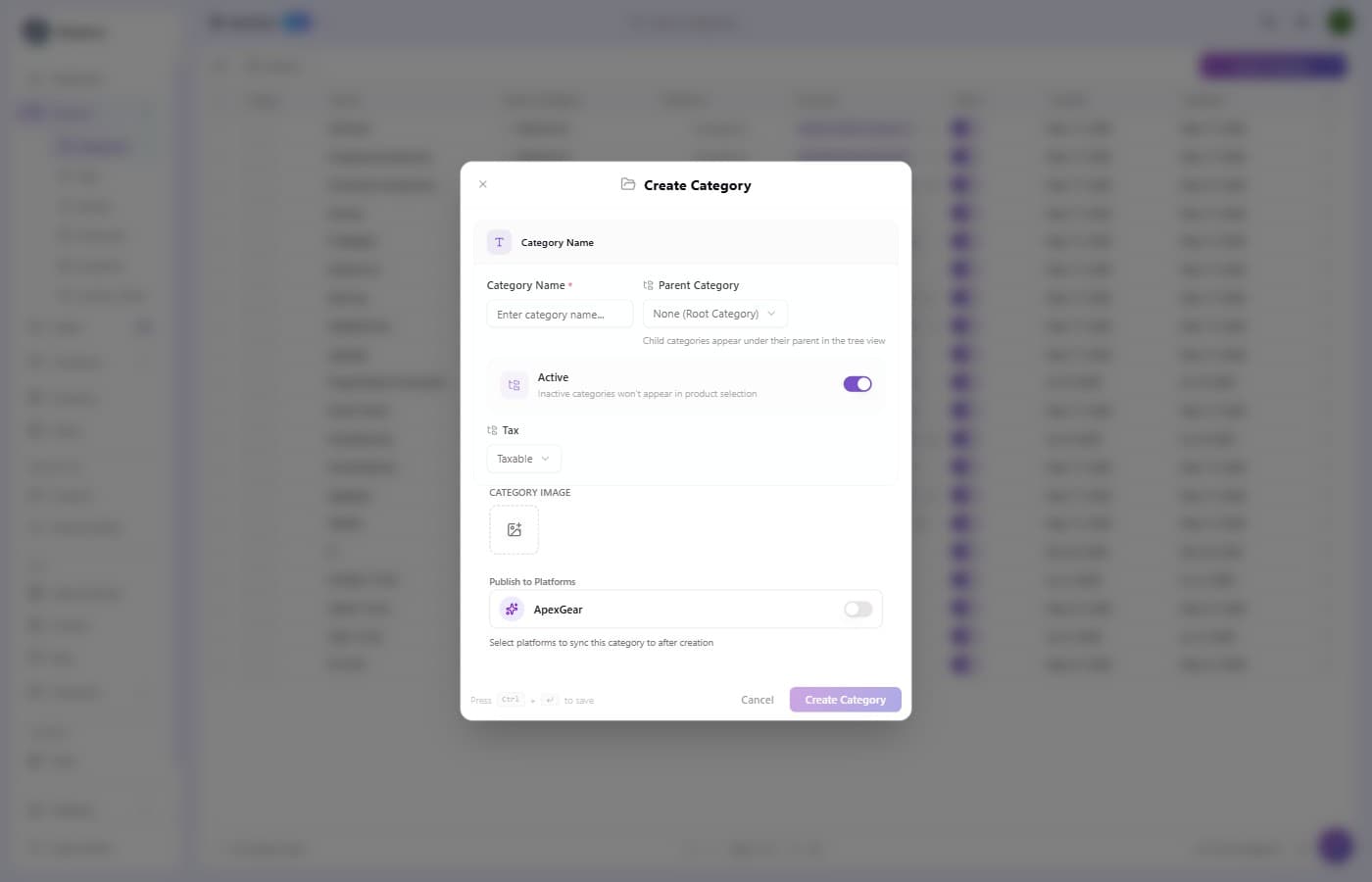
Click Create Category. The dialog has these fields:
| Field | What it does |
|---|---|
| Category Name | Required. Shown on the storefront and in navigation menus. |
| Parent Category | Leave as "None (Root Category)" for top-level. Pick a parent to nest this as a sub-category, and child categories appear indented under their parent in the tree view. |
| Active | Toggle OFF to hide the category from storefront navigation and product selection without deleting it. |
| Tax | "Taxable" or a custom tax class. Products in this category inherit the tax treatment unless overridden per-product. |
| Category Image | Optional image shown on the category landing page. |
| Publish to Platforms | Syncs the category to connected sales channels (Shopify, TikTok, etc.). Toggle on per channel after creation. |
Creating a sub-category
Set Parent Category to any existing category. There is no depth limit, so you can nest as deeply as you want, but 2 or 3 levels is usually enough for clear navigation.
Rules of thumb
- A product usually belongs to one category. Multi-category creates duplicate navigation entries.
- If removing the label would leave the product without a home in your menu → it's a category.
- Keep categories stable. Tags are the right place for things that change seasonally.
Tags
Tags are the flat, cross-cutting half of catalog organisation: bestseller, summer-sale, gift-under-50. They live at Products → Tags and have their own guide: Tags.
Don't see it in the sidebar? Tags is a module, and it can be switched off for a store; some store types start with it off. Turn it back on under Settings → Modules.
Categories vs Tags: the quick rule
| Question | Answer |
|---|---|
| Does the product need a permanent home in the navigation menu? | Category |
| Would I want a collection of products around this label that cuts across categories? | Tag |
| Is it seasonal or promotional? | Tag |
| Is the hierarchy important (Electronics → Phones → Smartphones)? | Category |
Worked example
A "Vintage Leather Wallet" by Bellroy on sale this month:
| Field | Value |
|---|---|
| Category | Accessories → Wallets |
| Tags | leather, summer-sale, gift-for-him, under-100 |
The category puts it in the right menu. The tags power a Summer Sale collection page and a "Gifts for Him under $100" filter. Without touching the product when the sale ends, just deactivate or remove the tag.
What's next?
- Add a product to assign categories and tags during product creation.
- Brands are the manufacturer or label that made the product.
- Attributes cover size, color, material and other variant-generating properties.