 Brainerce Help
Stock & inventory
Monitor stock across all products and SKUs, make instant adjustments from the inventory list, and understand how Available differs from total stock.
The Inventory page (sidebar → Inventory) gives you a single table across all your products and variants. You can see real-time stock, make adjustments inline, and spot low-stock products without opening each product individually.
No Inventory page at all? Stock tracking is a module, and stores set up to sell only digital goods or services start with it switched off, which removes the whole Inventory section, not just a sidebar link. Turn it on under Settings → Modules.
Key terms
| Term | What it means |
|---|---|
| Inventory | Total units you have on hand for this SKU. |
| Reserved | Units held by open orders that haven't been fulfilled yet. Brainerce locks these so they can't be double-sold. |
| Available | Inventory minus Reserved: the number new customers can actually buy. The storefront uses this to determine in-stock / out-of-stock. |
The inventory list
The page header shows summary badges: total products, total stock (with available count), low-stock count, and out-of-stock count. Products with variants show a > expand arrow.
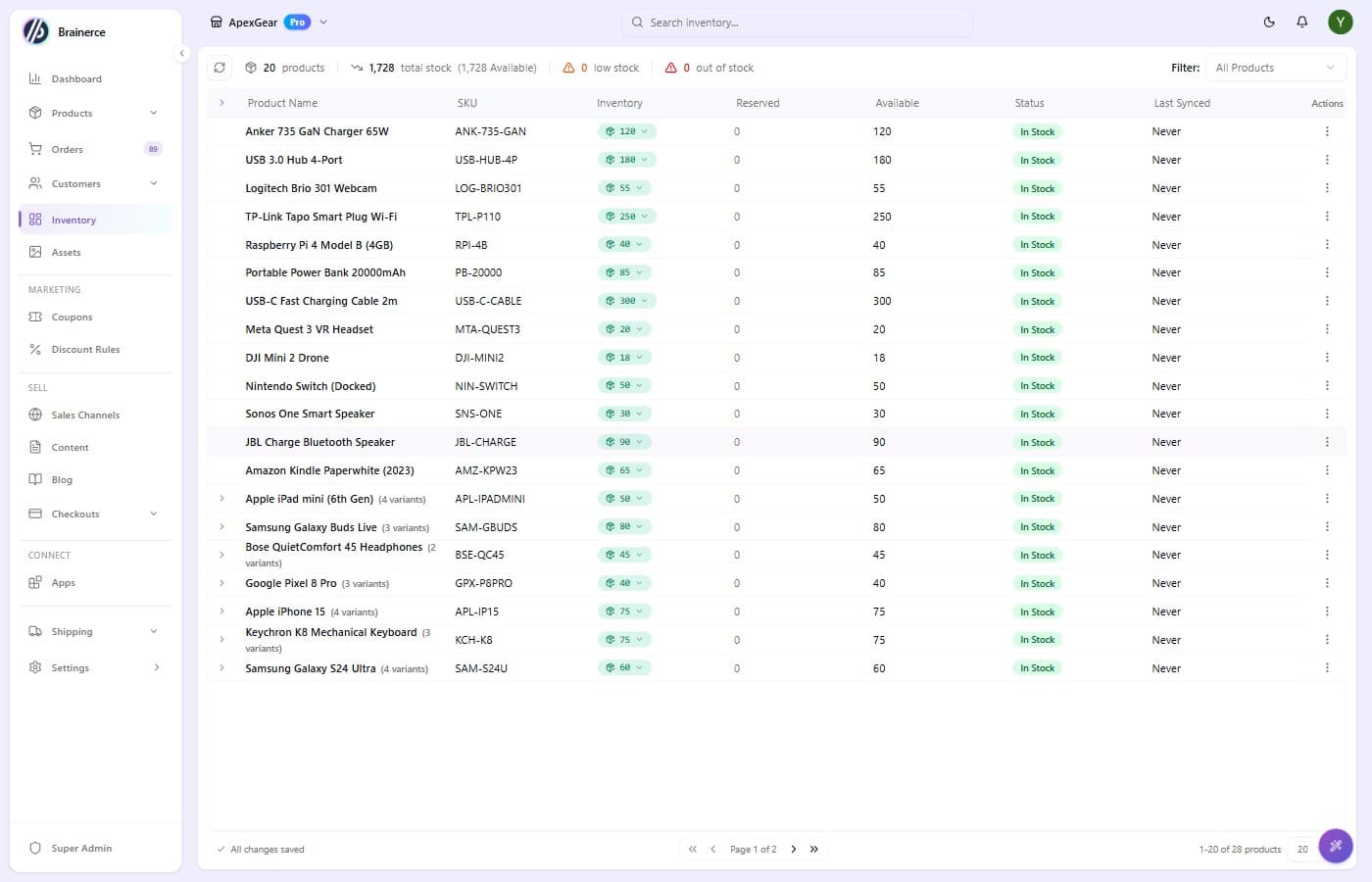
You can filter the list by status (All Products, In Stock, Low Stock, Out of Stock) using the dropdown in the top right.
Expanding variant rows
Products with multiple variants (size, color, storage, etc.) show a single parent row with the total stock. Click the > arrow to expand it and see every variant as its own row, each with its own SKU, inventory, reserved, and available count.
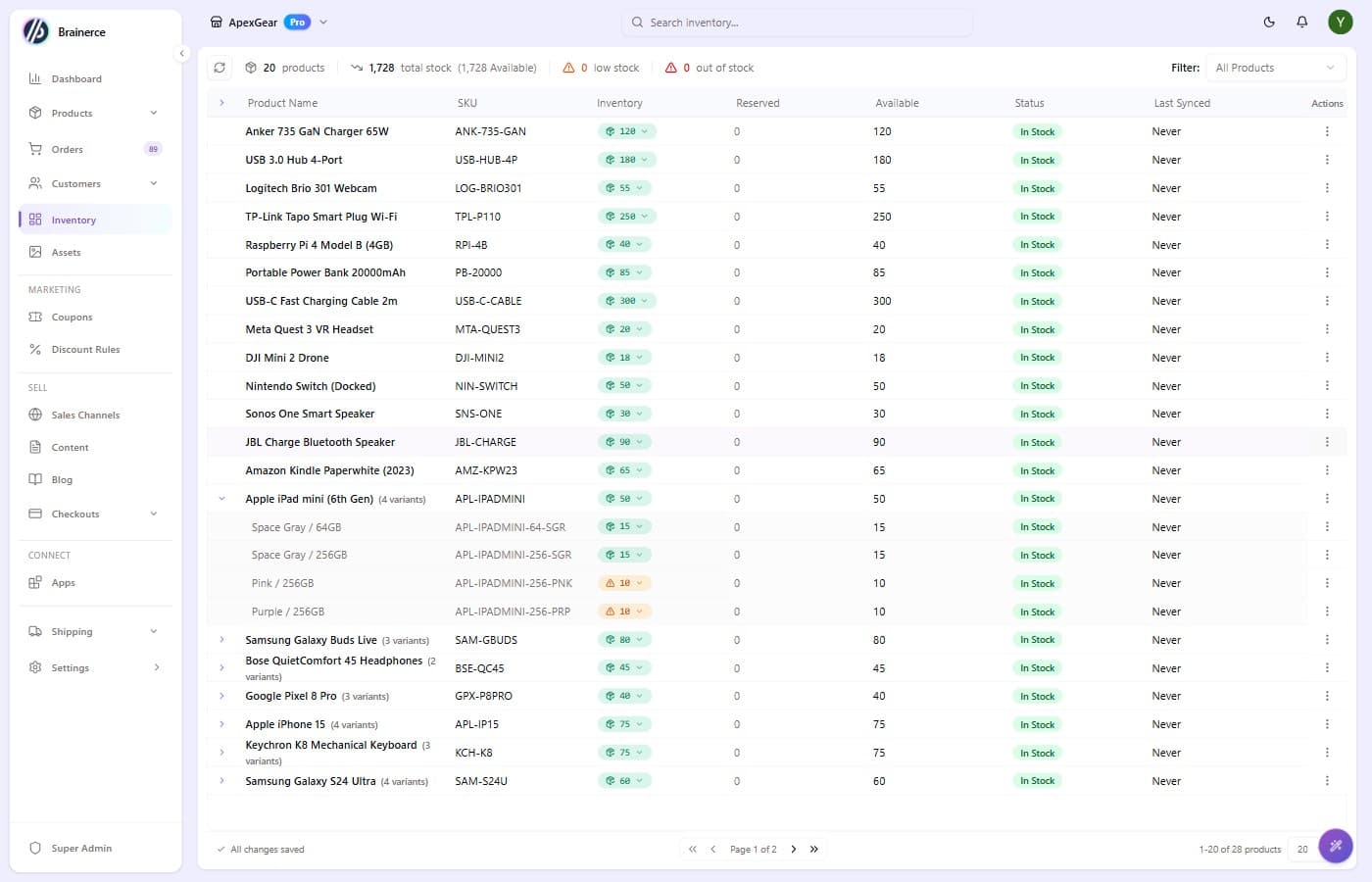
The warning triangle (⚠) on a variant row means its stock is at or below the low-stock threshold.
Making a stock adjustment
Click the green inventory badge on any row and a popover opens inline without navigating away:
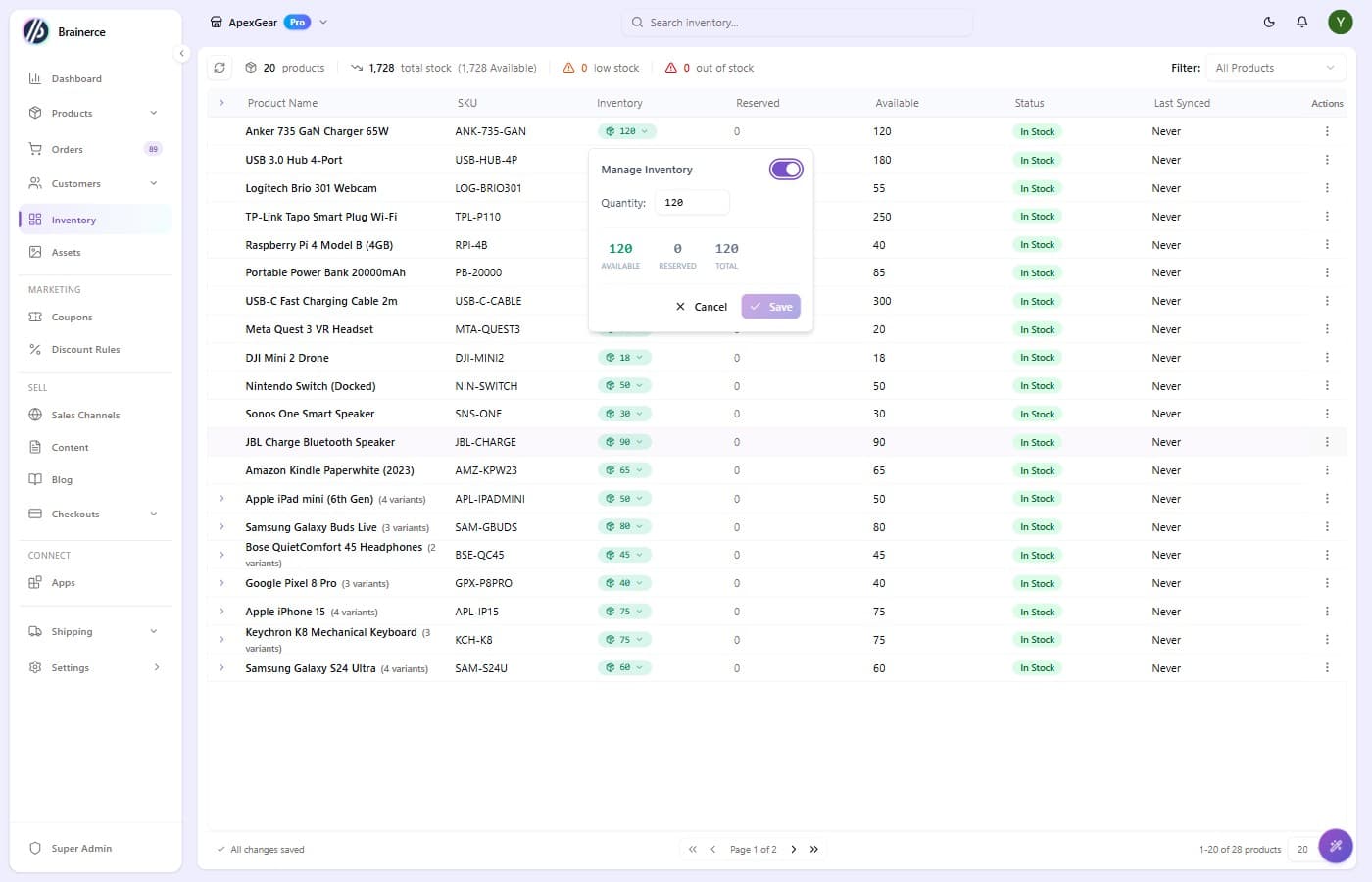
| Element | What it does |
|---|---|
| Manage Inventory toggle | ON = Brainerce tracks stock for this SKU. OFF = quantities are not tracked, and you pick the availability yourself: In Stock (always sellable) or Not for Sale (blocks purchase, and collects no back-in-stock waitlist). Useful for made-to-order or print-on-demand products. For a product that is temporarily sold out and coming back, leave the toggle ON and set the quantity to 0 instead. |
| Set total / Adjust by | Set total: type the quantity you have on hand right now. Adjust by: type the change instead (+30 for a delivery, -2 for breakage) and the popover shows the current count and what it becomes before you save. |
| Reason | Optional. Received shipment, damaged goods, return from customer, return to supplier, stock count, manual correction, or your own text. Saved with the movement so a count that looks wrong later can be traced. Left blank, the history records which screen the edit came from. |
| AVAILABLE / RESERVED / TOTAL | Live breakdown showing how the quantity you entered maps to what customers can buy vs what's locked in orders. |
Click Save and the change applies immediately and reflects on the storefront within seconds.
Updating every variant at once
On a product with variants, the parent row's popover lists each variant with its own Manage Inventory toggle and quantity. Above the list, All tracked variants applies one number to every variant that has tracking on: choose Set total or Adjust by, type the number, click Apply, and each row fills in with its before and after. Variants with tracking off are skipped. Fix any single size by hand, pick one reason for the whole save, and click Save. The button counts how many variants will change, and only those are written. Apply fills the fields, it does not save: nothing changes until Save.
A single variant's own row (expand the product with the > arrow) opens the same popover as a simple product, with Set total, Adjust by and a reason for that one variant.
Bulk updates: use the Inventory page's own importer: two columns, SKU and Stock. It matches product and variant SKUs. Do not reach for Bulk import from CSV: that importer only creates products, cannot change stock on one that already exists, and re-uploading a file duplicates your catalog. See Adjust stock levels.
Setting initial stock
When you create a product or add a variant, enter the starting quantity in the Inventory field of the product editor. Leave it at 0 to start out-of-stock, or set it to a positive number to go live immediately.
Why a kit's stock cell is blank and can't be edited
A kit, a gift box or bundle sold as one product, keeps no stock count of its own, so its row shows a blank stock cell and the popover does not open. This is not a bug and not a missing setting.
How many kits you can sell is derived from what is inside them, and the component that runs out first decides it. With 10 bottles and 12 glasses on hand, a box of one bottle plus two glasses is 6 boxes. Change the stock of the products inside the kit and the kit follows. A number typed onto the kit itself would never move when a bottle sold, so Brainerce does not accept one.
The same holds for Setting initial stock below: the product editor's Inventory field does not appear for a kit, because there is nothing to set.
Last Synced column
When a product is connected to an external sales channel (Shopify, WooCommerce, etc.), the Last Synced column shows when Brainerce last pushed an inventory update to that channel. "Never" means the product hasn't been synced yet, so check your sales channel connection settings.
What's next?
- Add a product to set starting stock during product creation.
- Adjust stock levels to update stock for many SKUs at once.
- Add variants to a product: each variant tracks inventory independently.
Bulk import products from CSV
Upload a CSV from Shopify, WooCommerce, Magento, or your own spreadsheet. Brainerce's AI maps every column for you, you review, and a hundred products land in seconds. Covers both importers, what each carries over, and what neither brings.
Back-in-stock waitlist
See who is waiting for a sold-out product to return, and how Brainerce emails them automatically when it does.