 Brainerce Help
Add variants to a product
Sell the same product in multiple sizes, colors, or storage tiers. Brainerce auto-generates one variant per combination so you only price and stock once per row.
A variant is a version of the same product: a 41mm Midnight Apple Watch is one variant of "Apple Watch Series 9". When customers see options on the storefront ("Pick a size, pick a color"), each combination they pick is a variant, and each variant tracks its own price, SKU, and inventory.
Quick steps
- Open the product you want to add variants to.
- Open the Manage Variations dialog (the variants editor).
- Add Product Attributes (Size, Color, Storage, …) and the values for each.
- Click Generate Variations and Brainerce creates one row per combination.
- Fill in Price, SKU, and Inventory per row, then Save Changes.
When you need variants, and when you don't
| Scenario | Use variants? |
|---|---|
| Same shirt in S, M, L, XL | Yes, one attribute (Size) |
| Apple Watch in 41mm / 45mm × Midnight / Starlight / Gold | Yes, two attributes (Size, Color) |
| Two unrelated products that happen to share a brand | No, make them separate products |
| Product with optional add-ons (engraving, gift wrap) | No, use Modifier groups instead |
| Subscription tiers (monthly / annual) | No. Build one standing order plan per tier |
The rule of thumb: if every combination has its own inventory count, it's a variant. If it's just a customer-side customization that doesn't change the SKU you ship, it's a modifier.
The Manage Variations dialog
Every variant edit happens in the same dialog. Open it from the product editor: click the gear icon ⚙️ next to the Variable Product type dropdown, or open any product that already has variants (Apple iPad mini, Apple Watch Series 9, Galaxy Tab S9 all ship with variants if you imported the demo CSV).
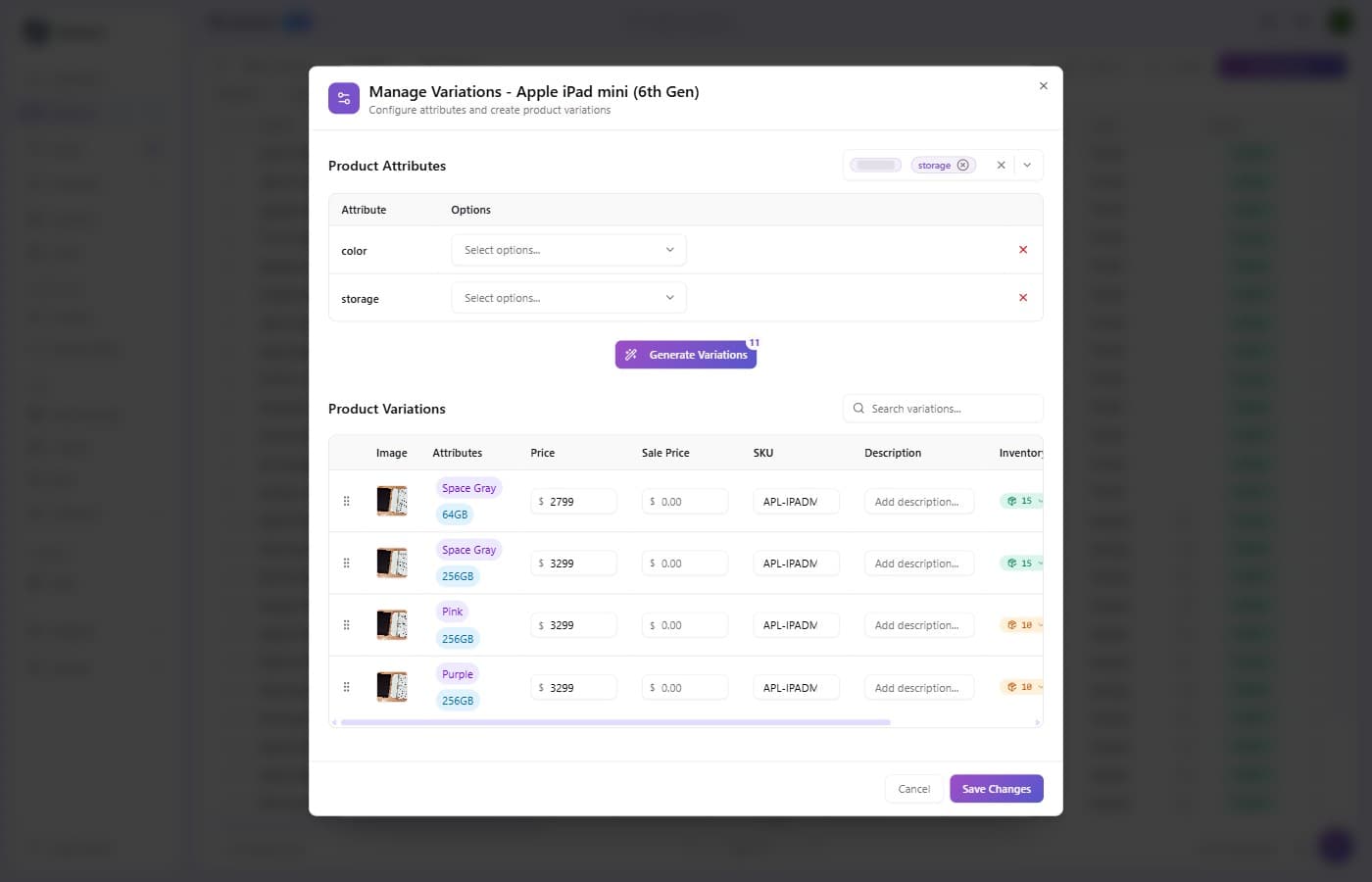
The dialog has three regions, top to bottom:
1. Product Attributes
The attributes are the option groups customers will choose between on the storefront. For Apple Watch that's size (41mm, 45mm) and color (Midnight, Starlight, Gold). For a t-shirt it'd be Size and Color. For an iPad it might be Storage and Connectivity.
To add an attribute:
- Pick from the suggestions in the chips at the top (
size,color) or type a new one (material,storage, …). - Click the Select options… dropdown next to it and add the values.
- Repeat for each attribute you want.
You can remove an attribute by clicking the × on the chip or the red × next to its row. The variants table re-generates immediately to reflect the change.
2. Generate Variations
The button in the middle is the magic. The badge on it (28 in the Apple Watch example) shows how many combinations the current attribute setup will produce, which is the Cartesian product of every attribute. Two attributes with 2 sizes × 14 colors = 28 variants.
Click it and Brainerce creates one row in the variants table for every combination. You don't have to write the variant names yourself; they're built from the attributes (41mm / Midnight, 41mm / Starlight, 45mm / Gold, …).
You don't have to keep all of them. If a combination doesn't actually exist (Apple sells
41mm Goldbut not45mm Goldin some markets), delete the row with the red trash icon. The product page on the storefront only shows real, in-stock variants.
3. Product Variations
This is the table where each variant gets its own data:
| Column | What it does |
|---|---|
| Image | Override the parent product image with a variant-specific one (e.g. show the actual color). |
| Attributes | The combination this row represents (read-only, set by Generate Variations). |
| Price | Defaults to the parent product price; a larger size usually costs more. |
| Sale Price | Optional per-variant sale. |
| SKU | Auto-suggested as <parent-SKU>-<short-code> (e.g. APL-AWS9-41-MID). Override freely. |
| MPN | Manufacturer Part Number, required by Google Shopping and most marketplace feeds. |
| Description | Per-variant blurb if it differs from the parent. |
| Inventory | Stock count, tracked independently. |
| Downloadable | Toggle on for digital-only variants (skips shipping at checkout). |
| Actions | Delete this variant row. |
When you're done, click Save Changes at the bottom-right of the dialog. The storefront updates within seconds.
How storefront shows variants
After saving:
- The product page on the storefront shows option selectors: radios, dropdowns, or swatches, depending on how each attribute is set to display and on how your shop was built.
- Price and stock update live as customers pick options.
- The product card on collection pages shows the lowest variant price as a "from $X.XX" label.
- A variant with
stock = 0shows Out of stock at checkout; the product as a whole is Out of stock only if every variant is at zero.
The default selected variant is whichever sits first in the variants table, so drag rows to reorder.
Bulk edit and per-channel overrides
Inside the variations dialog you can multi-select variant rows to bulk-edit them (price, sale price, stock, tracking, enabled) or bulk-delete. If you've connected marketplace channels (Shopify, TikTok, Meta, WooCommerce), the dialog also shows platform tabs so each variant can carry a different price, sale price, SKU, stock, or name per channel. SKUs are checked against your catalog as you type and warn if one is already taken.
Common patterns
Apparel: Size + Color
The textbook case. Two attributes; every combination has its own SKU and stock. For Color, set the display type to a color/image swatch on the attribute itself (see Attributes) so the storefront renders actual color squares instead of the words "Black" / "White".
Electronics: Storage + Connectivity (with gaps)
Apple iPad Pro: 128GB Wi-Fi, 256GB Wi-Fi, 256GB Wi-Fi + Cellular, 512GB Wi-Fi + Cellular. Note: fewer variants than the Cartesian product because some combinations don't exist (no 128GB Cellular). Delete the unwanted generated rows after Generate Variations.
Wearables: Size + Color × multiple finishes
Apple Watch Series 9 is the classic example: 2 sizes (41mm, 45mm) × 3 colors (Midnight, Starlight, Gold) = 6 variants per band material. Price often varies by size (the 45mm Watch costs $150 more than the 41mm).
Food: Spice level + Side
Pizza or curry: Mild + Rice, Mild + Naan, Spicy + Rice, Spicy + Naan. Same pattern as apparel.
Create many variants at once via CSV
For a brand-new product with 50+ variants, the CSV importer is faster than the dialog. See Bulk import products from CSV. On the AI import, variant rows are marked Type: variation and grouped under their parent Type: variable row.
You cannot bulk-edit variants this way. The product importer only ever creates: it never updates a product that already exists, so re-uploading a file to change variant prices or stock hands you a duplicate catalogue rather than an edit. To change many existing variants, use the products table (select the rows → Bulk Edit), or the Inventory page's own SKU-and-Stock importer for stock levels. The "Use the Brainerce template" import does not import variants at all.
What's next?
- Modifier groups are for add-ons that customize a variant at checkout (toppings, engraving, gift wrap) without creating a new variant.
- Bulk import is the fastest way to load hundreds of variants at once.
- Inventory tracking covers low-stock warnings and reservation timers for variants.
Translate products into another language
Sell in Hebrew, Arabic, Spanish or another language. Which product fields translate, how AI translation works, what stays the same in every language, and why your website may still show the wrong one.
Modifier groups (add-ons)
Per-checkout customizations such as engraving, warranty plans, accessory bundles and setup services. Includes Wolt-style "first N free" mechanics with 3 allocation policies, required vs optional choices, and per-product attachment.